Shipping Cost
Shipping Cost
1. Free Shipping [some exclusions]
2. Free shipping on orders over ₩30,000
Shipping Location
Shipping Location
Shipped from manufacturers located throughout South Korea
Shipping Policy
Shipping Policy
1. Immediate reshipment if the product is lost after dispatch
2. Immediate exchange if the received product is damaged
3. Same-day dispatch (before 12 PM) for next-day receipt
Delivery Company
Delivery Company
CJ Logistics, Logen Express, Korea Post EMS, Lotte Express, etc.
Delivery Scheduled
Delivery Scheduled
1. Purchases made before 12 PM will be received the next day.
2. Purchases made before 2 PM will be received the next day [certain items].
3. Purchases made after 12 PM/2 PM will be received two days later.
Return Policy
Return Policy
1. Returns accepted within 7 days of product receipt
2. Returns accepted within 3 months for products that differ from advertised description
3. Returns accepted within 30 days from the date the discrepancy was discovered
4. Live products are final sale and non-returnable
5. For simple returns, buyer is responsible for round-trip shipping costs
6. For returns due to seller's fault, round-trip shipping is free
Security Policy
Security Policy
Secure payments are made through world-renowned payment companies such as PayPal, Visa, and Mastercard. Your payment information will not be shared with any third parties.
Privacy Policy
Privacy Policy
Your personal information collected for payment and delivery will be securely protected during delivery and discarded after delivery is complete.
Shelled Freshwater Snails 200g
Shelled Freshwater Snails 200g
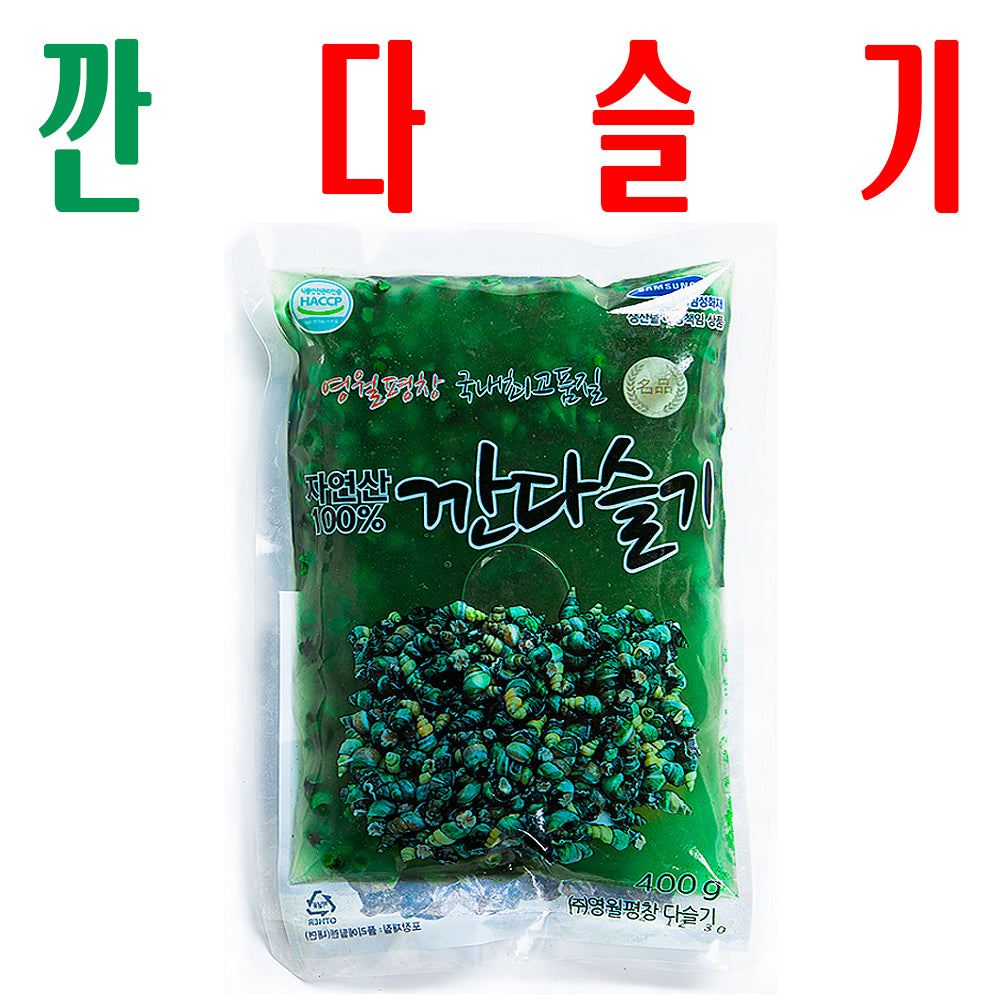
Marsh Snail/ freshwater snail
Peeled marsh snail/peeled freshwater snail/peeled godi/peeled daesari/peeled kkolpaengi
 |
||||||||||||||
|
What is a peeled marsh snail? Peeled marsh snail refers to marsh snail meat obtained by harvesting marsh snails that have grown in the clear waters of the Donggang River in Gangwon Province, undergoing sand expulsion and cleaning processes, and then boiling them to remove the shells. The flesh of the marsh snail is bluish in color, making it famous as a blue Color Food. Since it is prepared to be used immediately in cooking, you can use peeled marsh snails for a wide variety of dishes, such as hangover soup, porridge, noodles, kalguksu (knife-cut noodles), sujebi (hand-pulled dough soup), soybean paste stew, seasoned raw snail salad, pan-fried dishes, seaweed soup, and hot pots. Sand expulsion refers to the process of removing foreign substances inside the bodies of creatures living in the sea or rivers. Marsh snail sand expulsion refers to the act of removing river debris from inside the marsh snail shell. When you place marsh snails in water and make the environment dark, the nocturnal snails will push their flesh out of the shell to move, causing the foreign substances inside the shell to be expelled. The marsh snail product manufacturer, Yeongwol Pyeongchang Marsh Snail, has received Hazard Analysis and Critical Control Point (HACCP) certification from the Ministry of Food and Drug Safety, making their peeled marsh snail products more hygienic and safe. Here is a brief introduction to marsh snails. Marsh SnailThe marsh snail is one of the representative seafood items of early summer in Korea, and it can be seen relatively commonly in streams with clear flowing water. Marsh snail flesh is nutritionally excellent, being very rich in protein while also containing balanced amounts of carbohydrates, minerals, and fats. Because they are rich in the amino acid taurine, they are widely used as an ingredient for hangover soup today. Marsh snails are called by many different names depending on the region, such as olgaengi, freshwater snail, freshwater conch, conch, doseulbi, godi, godong, freshwater whelk, sora, daesari, kkolpaengi, and golbaengi. Because marsh snails were a familiar food for our ancestors, there are many regional dialects referring to them. Marsh snails inhabit most rivers and streams except for the far northern parts of the Korean Peninsula. Marsh snails are distributed in Korea, Japan (south of Hokkaido), Taiwan, and China. As mollusks living in rivers, lakes, streams, and ponds, they are called wara (蝸螺) in Sino-Korean, a term consisting of the characters for snail (蝸) and conch (螺). They are called wara (蝸螺) in Korea, senken (川蜷) in Japan, and danguquan (短溝蜷) in China. There are a total of 9 species under 3 genera (屬) in Korea: the marsh snail, freshwater marsh snail, pleated marsh snail, small-pleated marsh snail, bead marsh snail, striped bead marsh snail, rosary bead marsh snail, Gotsche's marsh snail, and pouch marsh snail. North Chungcheong Province in Korea is a region where many marsh snails are produced, and olgaengi hangover soup is famous there. The Donggang River in Yeongwol has many rosary bead marsh snails and bead marsh snails. Marsh Snail FarmingIn December 2010, marsh snail farming was successfully achieved for the first time in the world in Yesan, South Chungcheong Province. However, it is still too early to mass-produce marsh snails through farming to supply the food industry. Although they succeeded in farming marsh snails in Yesan using formula feed created by the National Institute of Fisheries Science, industrialization is difficult due to the issue of feed costs. Humans still do not know much about the ecology of the marsh snail. Currently, small-scale marsh snail farming is being attempted in about 15 places across Korea, using a method where marsh snails are hatched in farms and raised as young snails before being released into streams to grow into large snails. Even this method of farming is said to be not very easy. The annual demand for marsh snails in Korea is about 6,000–7,000 tons, consumed as food in large cities, but since domestic production is only about 2,000–3,000 tons per year, the rest is being met through imports. Needless to say, the imported ones are also all wild-caught. This is because they cannot be farmed in foreign countries either. Why Marsh Snails Are FamousThe reason marsh snails became famous is because of the folk medicine practitioner Kim Il-hoon (pen name Insan), who lived in Hamyang, Gyeongsangnam-do. During his lifetime, Mr. Insan was the developer of Insan bamboo salt, which is made by putting salt in bamboo and roasting it nine times. Mr. Insan is famous for having helped many people by processing animals and plants commonly found around us in unique ways. Mr. Insan’s descendants and enthusiasts of folk medicine have established the Insan Oriental Medicine Clinic, Insan Bamboo Salt Co., Ltd., and the Insan Philosophy Association to uphold his legacy. Mr. Insan treated marsh snails based on the energy of an object's color. Just as he developed bamboo salt by using the white energy of salt (白) and the red fire energy (火) of high heat, he created marsh snail oil by using the blue energy (靑) of marsh snail flesh and the red fire energy (火) of high heat. As the marsh snail oil developed by Mr. Insan became extremely famous, the reputation of the marsh snail itself also rose. Even today, 40 years after the development of marsh snail oil, products like marsh snail extract, peeled marsh snails, and marsh snail broth are commercialized and consumed nationwide. Below is the appearance of the marsh snail flesh, which has a blue energy. |
||||||||||||||
|
||||||||||||||
Composition of Marsh SnailsBelow is the general composition table of marsh snail flesh. Dry matter basis means the content ratio calculated excluding moisture. |
||||||||||||||
|
||||||||||||||
|
The above composition analysis result is not for marsh snail oil but for marsh snail flesh. Since marsh snail oil is made by melting marsh snail flesh, one can generally understand the composition of marsh snail oil by examining the marsh snail flesh. Let's briefly look at the general composition of marsh snail flesh.
The characteristic of marsh snail’s general composition is that it is high in protein, and its nutrients are not biased but are abundantly and evenly contained. |
||||||||||||||

| 1). | These are peeled wild marsh snails that inhabit the Donggang River (Yeongwol and Pyeongchang area), the upper reaches of the Namhan River, which is famous for its clean water. |
| 2). | It is a pure natural product that does not come into contact with any artificial compounds during the process of producing shelled freshwater snails. |
| 3). | It is covered by product liability insurance, so you can receive compensation if damages occur from the product. |
| 4). | As the shelled freshwater snails are produced according to Hazard Analysis and Critical Control Point (HACCP) standards, they are highly hygienic and safe. |
| Introduction |
The producer/supplier of this product is Yeongwol Pyeongchang Freshwater Snail Co., Ltd. (CEO: Cho Byeong-chan). About 25 years ago, CEO Cho was engaged in the wholesale and retail of freshwater snails while also harvesting them in the Donggang River and Jecheon areas. Fascinated by the benefits of freshwater snails, CEO Cho established the private enterprise Yeongwol Pyeongchang Freshwater Snail in 2009 and began producing processed snail products. In 2020, based on 25 years of experience in harvesting, processing, and selling freshwater snails, he established the specialized processing company Yeongwol Pyeongchang Freshwater Snail Co., Ltd. Yeongwol Pyeongchang Freshwater Snail Co., Ltd. received HACCP (Hazard Analysis and Critical Control Point) certification from the Ministry of Food and Drug Safety in 2022. As of 2024, it produces and sells freshwater snail oil, snail concentrate, raw snails, shelled snails, snails for broth, and snail broth. Yeongwol Pyeongchang Freshwater Snail Co., Ltd. takes pride in being a company that produces hygienic and safe freshwater snail products. Here is a brief introduction to Yeongwol Pyeongchang Freshwater Snail Co., Ltd. |
|---|---|
| Name | Yeongwol Pyeongchang Freshwater Snail Co., Ltd. (CEO: Cho Byeong-chan) |
| Address | 130-37, Palgoe-ro, Yeongwol-eup, Yeongwol-gun, Gangwon-do |

|
|
| 010-3352-7949 |
| 1). | You may gently warm the shelled snails and eat them as they are. |
| 2). | It is recommended to use them as an ingredient for noodles, kalguksu (knife-cut noodles), sujebi (hand-pulled dough soup), seaweed soup, soybean paste soup, stews, and hangover soups. |
| 3). | You can also use them as ingredients for pancakes, seasoned dishes, and rice cake soup (tteokguk). |
| 4). | Please store the shelled snails in the freezer immediately upon taking them out of the icebox. |
| 5). | Please store in the freezer. |
| Origin | South Korea (Yeongwol, Pyeongchang, Jecheon) |
|---|---|
| Geographical Indication | Not applicable |
| Product Composition | 100% true freshwater snails (Semisulcospira coreana) or 'bead' freshwater snails |
| Sales Unit | Pack (The icebox contains small packs of shelled snails and ice packs) |
|---|---|
| Total Content |
Small: Shelled snails 200g x 1 pack, Large: Shelled snails 400g x 1 pack Composition per pack: 25% snails, 75% broth |
| Servings | When making snail soup, a 200g pack serves 3, and a 400g pack serves 6. |
| Food Type | Marine product |
|---|---|
| Production Date | Packaging date is the production date, as items are packaged and shipped from the manufacturer/supplier's cold storage; you may verify this by calling: 033-373-6123 |
| Expiry Date | Indicated on the packaging; 3 months after packaging; you may verify the expiry date by calling: 033-373-6123 |
This is a food product with no applicable legal requirements. |
Not applicable under the law. |
Not applicable under the law. |
| Payment Info |
1). For bank transfer payments, please deposit the purchase amount via PC banking, internet banking, phone banking, or a bank counter. |
|---|---|
| Shipping Info |
1). Delivery Method: Parcel Service 2). Delivery Region: Nationwide 3). Delivery Fee: Generally free, but some charges may apply. 4). Delivery Period: 1–3 days: - Payments made before 3:00 PM are delivered the next day; payments after 3:00 PM are delivered the following day. 5). Notes: Additional shipping fees may apply for island regions. For bank transfers, shipping begins only after the deposit is confirmed. Delivery may be delayed during holidays or due to carrier circumstances. |
| Exchange/Return |
1). Conditions for Exchange/Return - Exchange/return is possible within 7 days of receiving the product. - If the product differs from the description/advertisement, within 3 months of receipt or 30 days of discovering the fact. 2). Non-returnable Items (in accordance with the E-Commerce Act): - Loss or damage caused by the customer (excluding damage caused to inspect the product). - If the package is opened or damaged, losing its commercial value. - If the product value has significantly decreased due to use or partial consumption by the customer. - If the value has decreased significantly due to the passage of time, making resale difficult. - If the packaging of reproducible products has been damaged. 3). Warranty conditions and quality standards follow the "Consumer Basic Act". 4). Notes: If an exchange/return is requested due to a change of mind, the customer is responsible for the shipping costs. |
| Consumer Dispute Resolution |
Fair Trade Commission Consumer Dispute Resolution Standards |
| Terms of Use | Terms of Service(https://bit.ly/3qDTO1Q) |
Shipping Cost
Shipping Cost
1. Free Shipping [some exclusions]
2. Free shipping on orders over ₩30,000
Shipping Location
Shipping Location
Shipped from manufacturers located throughout South Korea
Shipping Policy
Shipping Policy
1. Immediate reshipment if the product is lost after dispatch
2. Immediate exchange if the received product is damaged
3. Same-day dispatch (before 12 PM) for next-day receipt
Delivery Company
Delivery Company
CJ Logistics, Logen Express, Korea Post EMS, Lotte Express, etc.
Delivery Scheduled
Delivery Scheduled
1. Purchases made before 12 PM will be received the next day.
2. Purchases made before 2 PM will be received the next day [certain items].
3. Purchases made after 12 PM/2 PM will be received two days later.
Return Policy
Return Policy
1. Returns accepted within 7 days of product receipt
2. Returns accepted within 3 months for products that differ from advertised description
3. Returns accepted within 30 days from the date the discrepancy was discovered
4. Live products are final sale and non-returnable
5. For simple returns, buyer is responsible for round-trip shipping costs
6. For returns due to seller's fault, round-trip shipping is free
Security Policy
Security Policy
Secure payments are made through world-renowned payment companies such as PayPal, Visa, and Mastercard. Your payment information will not be shared with any third parties.
Privacy Policy
Privacy Policy
Your personal information collected for payment and delivery will be securely protected during delivery and discarded after delivery is complete.