Shipping Cost
Shipping Cost
1. Free Shipping [some exclusions]
2. Free shipping on orders over ₩30,000
Shipping Location
Shipping Location
Shipped from manufacturers located throughout South Korea
Shipping Policy
Shipping Policy
1. Immediate reshipment if the product is lost after dispatch
2. Immediate exchange if the received product is damaged
3. Same-day dispatch (before 12 PM) for next-day receipt
Delivery Company
Delivery Company
CJ Logistics, Logen Express, Korea Post EMS, Lotte Express, etc.
Delivery Scheduled
Delivery Scheduled
1. Purchases made before 12 PM will be received the next day.
2. Purchases made before 2 PM will be received the next day [certain items].
3. Purchases made after 12 PM/2 PM will be received two days later.
Return Policy
Return Policy
1. Returns accepted within 7 days of product receipt
2. Returns accepted within 3 months for products that differ from advertised description
3. Returns accepted within 30 days from the date the discrepancy was discovered
4. Live products are final sale and non-returnable
5. For simple returns, buyer is responsible for round-trip shipping costs
6. For returns due to seller's fault, round-trip shipping is free
Security Policy
Security Policy
Secure payments are made through world-renowned payment companies such as PayPal, Visa, and Mastercard. Your payment information will not be shared with any third parties.
Privacy Policy
Privacy Policy
Your personal information collected for payment and delivery will be securely protected during delivery and discarded after delivery is complete.
Wild-simulated ginseng / Mountain-cultivated ginseng / Wild-crafted ginseng / 7-8 years old authentic product
Wild-simulated ginseng / Mountain-cultivated ginseng / Wild-crafted ginseng / 7-8 years old authentic product
Wild Ginseng
Mountain-Cultivated Wild Ginseng/Sanyang-samsam/Jinsangbin Mountain-Cultivated Wild Ginseng/Dodam Mountain Ginseng/Certified Mountain-Cultivated Ginseng

|
||||||||||||||||||||
What is mountain-cultivated wild ginseng (Sanyang-samsam)?Sanyang-samsam refers to ginseng grown in a natural state after human beings collect wild ginseng seeds and scatter them in the mountains. In other words, Sanyang-samsam is ginseng "raised" (養) in the mountains (山). Ginseng grown by scattering seeds in the mountains or by transplanting seedlings raised in fields into the mountains to grow naturally is also called Sanyang-samsam, and it is sometimes referred to as Jangnoe-samsam. Sanyang-samsam production usually begins after 5-6 years; as the survival rate drops sharply with time, the price of aged, high-year-root Sanyang-samsam increases significantly. Let us briefly introduce ginseng. Ginseng (Sam)Sam is a general term for plants from which coarse, long hemp fibers can be extracted, including hemp, flax, and ramie; it is a native Korean word that has appeared in records since the 15th century, after the creation of Hangul. The Hanja Sam (蔘) is a character used as part of plant names such as insam (cultivated ginseng), sansam (wild ginseng), dongsam, dangsam, mansam, and bongsam. Because the roots resemble the human form, the Chinese term Insam (人蔘 = person 人, ginseng 蔘) was created. Just as a wild ginseng digger is called 'Simmani' in Korean, Sim is a native word referring to wild ginseng, and it is presumed that the 'Sim' in Simmani originated from 'Sam'. Insam and SansamInsam (cultivated ginseng) is a globally famous representative health food of Korea. Since its origin is our land, it has been with our ancestors for ages. Sansam (wild ginseng) belongs to the same species as insam in terms of plant taxonomy. The term "insam" originally referred to plants growing in the mountains, but once cultivation began, the term "insam" became the name for the cultivated variety, and sansam was coined to distinguish the wild-growing variety. Thus, sansam refers to wild-type ginseng, while insam refers to the cultivated variety. The roots of cultivated ginseng and wild ginseng show several differences. First, cultivated ginseng is much larger than wild ginseng. Second, cultivated ginseng lacks the horizontal rings (=transverse wrinkles/rings) on the body that wild ginseng possesses. Third, the rootlets of cultivated ginseng are soft and break easily, whereas wild ginseng rootlets are tough and resilient. Fourth, wild ginseng has okju (pearl-like tubercles) remaining where smaller rootlets fell off, whereas cultivated ginseng does not. Fifth, the rhizome (head) of cultivated ginseng is very thick and short, while that of wild ginseng is thin and long. Cultivated ginseng grows quickly with human assistance and is harvested in 5-6 years, while wild ginseng grows on its own in harsh environments without human help, developing over decades or even centuries, which leads to these distinct characteristics. Because wild ginseng appears as a mystical plant in Korean folklore and historical literature, it is still perceived as a very mysterious entity by modern people today. Consequently, wild ginseng remains highly valued, and its trading price is very high. Below are photos of wild ginseng and cultivated ginseng. |
||||||||||||||||||||

|
||||||||||||||||||||
|
As shown in the photo above, there is a clear difference in the length of the rhizome between cultivated ginseng and wild ginseng. The rhizome refers to the connecting part between the top of the plant where the stalk emerges in spring and the main body. Since new sprouts emerge from the top of the rhizome (the "hairpin" tip) every spring, traces of time remain on it. While these marks help estimate the age of wild ginseng, one cannot rely solely on the rhizome to determine the age, as there are years when stalks do not sprout. Types of Wild GinsengWild ginseng is broadly divided into three types: Cheonjong-sansam (heaven-sent), Sanyang-sansam (mountain-cultivated), and Jangnoe-sansam (long-rhizome). They can also be classified as Cheonjong (heaven-bred), Jijong (earth-bred), and Injong (human-bred). Cheonjong-sansamCheonjong-sansam (Heavenly variety) refers to wild ginseng that has been living and propagating in the mountains for generations since its first appearance. This is the variety that has been aged for decades or centuries; it is the ginseng that Simmani (ginseng diggers) would seek after performing cleansing rituals and mountain deity rites. It is the type of ginseng that has birthed numerous myths and legends. The price of Cheonjong-sansam is determined by experts. It lives in the deep mountains throughout Korea (excluding Jeju Island), northeastern China, and the Russian Far East. Sanyang-sansamSanyang-sansam (Mountain-raised ginseng) refers to wild ginseng seeds that have been scattered in the mountains by humans and left to grow on their own in a natural state; it is often shortened to Sanyang-sam. Historically, it began to appear around the late Goryeo Dynasty. Since humans only intervene in dispersing the seeds and not in the growth process, it is essentially no different from Cheonjong-sansam, but because human intervention occurred, it is not valued as highly as Cheonjong-sansam. Jangnoe-sansamJangnoe-sansam (Long-rhizome ginseng) means, as the Hanja implies, wild ginseng with a long (Jang) rhizome (Noe); it is also shortened to Jangnoe-sam. This term is used to distinguish it from pure wild ginseng. While it possesses the characteristics of wild ginseng, it is not considered "perfect" wild ginseng like Cheonjong or Sanyang-sansam. There are three types of Jangnoe-sam: first, Sanjang-noe, which grows in the mountains after animals eat cultivated ginseng seeds and disperse them through excrement; second, Ssi-jangnoe, where people scatter seeds in the mountains; and third, Myo-jangnoe, where seedlings from a ginseng field are transplanted into the mountains. In China, because it is transplanted, it is called Isansam (moved-mountain ginseng). Although the seeds of Jangnoe-sam are from cultivated ginseng, because they grow on their own or are raised in a mountain environment where wild ginseng thrives, Jangnoe-sam also shares the characteristics of wild ginseng. Since it is also raised in the mountains, it is sometimes called Sanyang-sam. However, the clear difference between Jangnoe-sam and Sanyang-sam lies in the origin of the seeds. Below are photos of a pure wild species, Cheonjong-sansam, and a 5-6-year-old Sanyang-sansam. |
||||||||||||||||||||

|
||||||||||||||||||||
|
Looking at the Cheonjong-sansam on the left above, there appear to be three main bodies; two of them were formed as the teoksu of the rhizome transformed. Teoksu refers to fine roots that stretch out like whiskers from the left and right of the rhizome. Sometimes these roots grow to the size of the main body. Such wild ginseng is called Yanggak-yeonjeolsam (Sheep-horn jointed ginseng). Since ancient times, wild ginseng with four or more bodies has been regarded as a top-tier specialty product fit for kings. You can also see the clear development of the rhizome in the young Sanyang-sansam on the right. Why Sanyang-sansam is more expensive than cultivated ginsengThe reasons why Sanyang-sansam, which is much smaller than cultivated ginseng, is more expensive are: first, the years of growth are much longer; second, the saponin content is significantly higher; and third, Rg3 and Rh2 saponins, which are highly valued in red ginseng, are key components of Sanyang-sansam. In the past, Sanyang-sansam was grown for decades before being commercialized, making it extremely expensive, but nowadays it is commercialized earlier—after 5-6, 7, 10, or 12 years—making it more affordable. Since history began, wild ginseng has been a special health ingredient that only a select few, such as royalty or high-ranking officials, could enjoy. Today, even ordinary citizens can afford to try Sanyang-sansam. Because Cheonjong-sansam is so rare, it remains difficult for anyone but the very wealthy to obtain. |
||||||||||||||||||||
Components of GinsengBelow is the general composition table for ginseng. Since ginseng, Sanyang-sansam, and wild ginseng are biologically the same species, one can indirectly understand the composition of Sanyang-sansam and wild ginseng by examining the composition of cultivated ginseng. "Dry weight basis" means that the moisture was completely excluded during composition analysis. |
||||||||||||||||||||
|
||||||||||||||||||||
|
A notable point in the composition of ginseng is that it is rich in protein. Ginseng also contains a fair amount of sugar, so you might taste sweetness, but the bitterness of the saponin tends to mask it. Ginseng, Sanyang-sansam, and wild ginseng all have a decent taste when eaten raw. Ginseng does not contain much dietary fiber, so it is easy to chew. We will briefly introduce a few important, special, and trace components of ginseng or Sanyang-sansam.
Ginseng is produced in Korea, China, Japan, the US, and Canada, but ginseng grown in foreign countries is a different species from ours. Goryeo ginseng (brand name) produced in Korea is evaluated as having the world's best quality compared to foreign ginseng due to its higher saponin content and far superior variety of saponins.
|
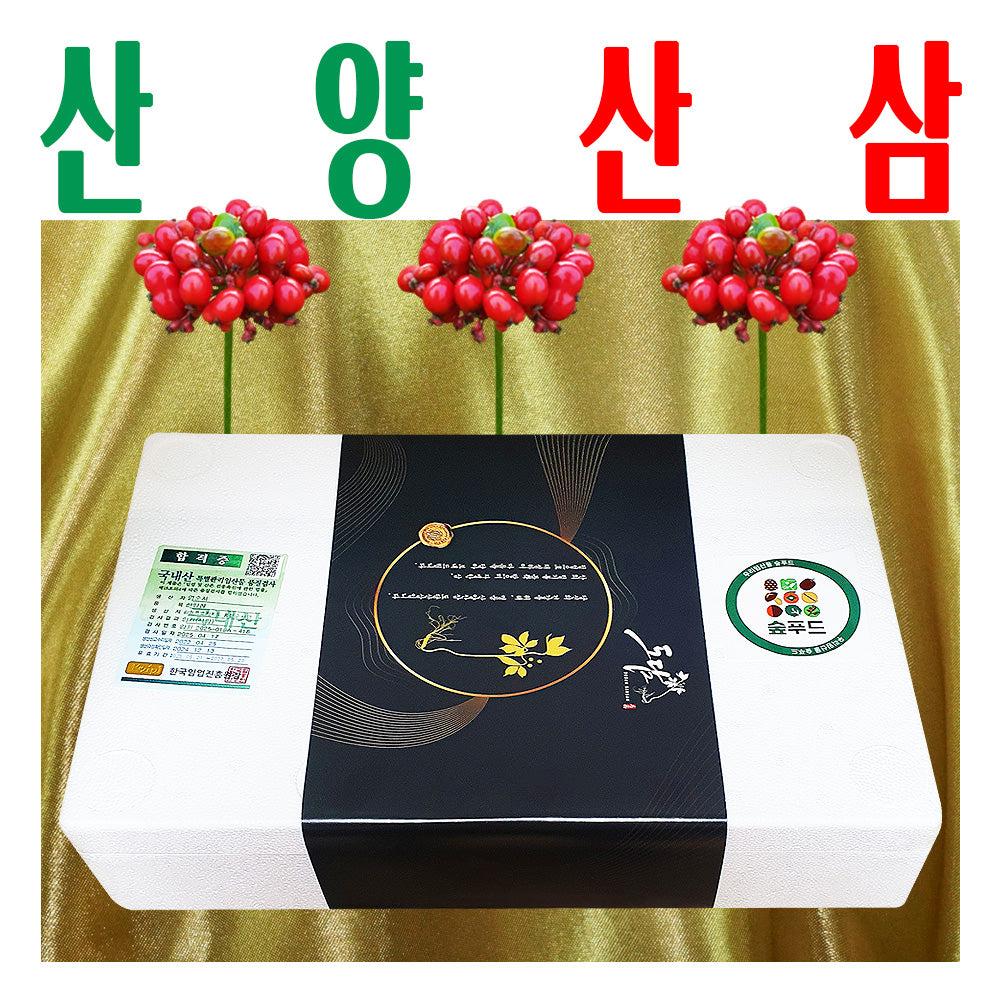
| 1). | It is Sanyang-sansam that has passed the quality inspection for domestically produced specially managed forest products by the Korea Forestry Promotion Institute. |
| 2). | Sanyang-sansam harvested and shipped between May and August each year is delivered as the original product with stalks (leaves and stems) attached. |
| 3). | Sanyang-sansam harvested and shipped between September and April each year is delivered as just the main body with the rhizome, without stalks (leaves and stems). |
| 4). | Whether it has stalks or not, we only ship certified authentic products with well-preserved rootlets during the harvesting and sorting process. |
| About Us |
The producer/supplier of the Sanyang-sansam is Minguk Sansam, which cultivates and produces it in Hoengseong-gun, Gangwon-do. They possess the premium brand Dodam, a luxury brand that distributes high-quality Sanyang-sansam produced in Hoengseong-gun domestically. Minguk Sansam is a company where several producers, including representative Jinsangbin and Yeom Sun-ja, work together. |
|---|---|
| Name | Minguk Sansam (Representative: Jinsangbin) |
| Address | 3F, 1440 Hanwoo-ro, Mucheon-myeon, Hoengseong-gun, Gangwon-do; Shipping address: #103, 1992 Chiak-ro, Wonju-si, Gangwon-do |
| 010-3352-7949 |
| 1). | You may consume it once a day, either in the morning after waking up or at night before bed. |
| 2). | Wash the mountain-cultivated wild ginseng thoroughly under running water. |
| 3). | Rinse your mouth with bottled water, then chew the mountain-cultivated wild ginseng slowly for at least 10 minutes. |
| 4). | It is recommended to avoid alcohol one day before and throughout the period of consuming the mountain-cultivated wild ginseng. |
| 5). | If the mountain-cultivated wild ginseng comes with stems and leaves, chew the entire plant including the leaves and stems slowly for at least 10 minutes along with the root. |
| 6). | You can also boil it for a long time and drink it as a concentrated extract. |
| 7). | You can put the mountain-cultivated wild ginseng in a blender with milk and honey to make a smoothie. |
| 8). | You can also use it to make mountain-cultivated wild ginseng liquor. |
| 9). | You can use mountain-cultivated wild ginseng instead of fresh ginseng when making samgyetang (ginseng chicken soup). |
| 10). | You can separate the leaves and stems from the roots, put them in water, and boil them to drink as a tea. |
| 11). | To store in the refrigerator, spray water on the moss, wrap the moss with Korean paper (Hanji) or newspaper. Details are provided in the booklet included with your delivery. |
| Origin | South Korea (Hoengseong-gun) |
|---|---|
| Geographical Indication | Not applicable |
| Product Composition | 100% Raw 7-8 year old Mountain-Cultivated Wild Ginseng |
| Sales Unit | Box (Mountain-cultivated wild ginseng + consumption guide + gift wrapping cloth) |
|---|---|
| Total Net Weight |
5 roots: 85g -+10g, 10 roots: 170g+-20g, 15 roots: 255g+-30g, 20 roots: 340g+-40g Typically, the weight of one root is about 15g-20g. |
| Consumption Period | If consuming 1 root per day, you can consume it for 5, 10, 15, or 20 days. |
| Box Size | Width 28cm, Length 42cm, Height 9cm (based on a 5-root premium box) |
| Food Type | Agricultural Product |
|---|---|
| Production Date | Harvested within 15 days from the order date. As the producer ships on the day of harvest, the shipping date is the production date. Verification phone: 010-3016-6426 |
| Shelf Life | At least 2 weeks to maximum 1 month from the shipping date if refrigerated. Even at room temperature, it can maintain freshness for about 1 week if the moisture of the moss is kept well. Verification phone: 010-3016-6426 |
| Not legally applicable. |
| Not legally applicable. |
| Not legally applicable. |
| Payment Information |
1). For bank transfers, payment can be made via PC banking, internet banking, phone banking, or at the bank. - The name of the depositor entered during the order must match the name of the account holder. Orders not paid within 3 days will be automatically canceled. 2). For credit card or simple payments, the payment system processes it immediately, so no additional steps are required. |
|---|---|
| Delivery Information |
1). Delivery Method: Courier service 2). Delivery Region: Nationwide 3). Delivery Fee: Generally free, some paid options apply 4). Delivery Period: 1~3 days: - Payment before 3:00 PM allows receipt the next day; payment after 3:00 PM allows receipt the day after next. 5). Notes :- Additional shipping fees may apply for island regions. - For bank transfers, delivery begins after payment is confirmed. - Delivery may be slightly delayed during holidays or special circumstances involving the courier company. |
| Exchange/Return |
1). Situations eligible for exchange or return
- Exchange/return is possible within 7 days from the date of receipt. - If the product differs from the description/advertisement, within 3 months of receipt or within 30 days of discovering the discrepancy. 2). Situations where exchange or return is NOT possible (per the "Act on Consumer Protection in Electronic Commerce"):- If the product is lost or damaged due to the customer's fault (excluding cases where packaging was damaged to inspect the product). - If the packaging has been opened or damaged, resulting in the loss of product value. - If the value of the product has significantly decreased due to customer use or partial consumption. - If the value has significantly decreased due to time elapsed, making resale difficult. - If packaging of products that can be replicated is damaged. 3). Regarding warranty conditions and quality standards, the "Framework Act on Consumers" applies.4). Notes: - If you request an exchange or return due to a change of mind, you are responsible for the shipping costs. |
| Compensation for Damages, Complaints, and Disputes |
Fair Trade Commission Consumer Dispute Resolution Standards |
| Terms of Trade | Terms of Service (https://bit.ly/3qDTO1Q) |
Shipping Cost
Shipping Cost
1. Free Shipping [some exclusions]
2. Free shipping on orders over ₩30,000
Shipping Location
Shipping Location
Shipped from manufacturers located throughout South Korea
Shipping Policy
Shipping Policy
1. Immediate reshipment if the product is lost after dispatch
2. Immediate exchange if the received product is damaged
3. Same-day dispatch (before 12 PM) for next-day receipt
Delivery Company
Delivery Company
CJ Logistics, Logen Express, Korea Post EMS, Lotte Express, etc.
Delivery Scheduled
Delivery Scheduled
1. Purchases made before 12 PM will be received the next day.
2. Purchases made before 2 PM will be received the next day [certain items].
3. Purchases made after 12 PM/2 PM will be received two days later.
Return Policy
Return Policy
1. Returns accepted within 7 days of product receipt
2. Returns accepted within 3 months for products that differ from advertised description
3. Returns accepted within 30 days from the date the discrepancy was discovered
4. Live products are final sale and non-returnable
5. For simple returns, buyer is responsible for round-trip shipping costs
6. For returns due to seller's fault, round-trip shipping is free
Security Policy
Security Policy
Secure payments are made through world-renowned payment companies such as PayPal, Visa, and Mastercard. Your payment information will not be shared with any third parties.
Privacy Policy
Privacy Policy
Your personal information collected for payment and delivery will be securely protected during delivery and discarded after delivery is complete.