Shipping Cost
Shipping Cost
1. Free Shipping [some exclusions]
2. Free shipping on orders over ₩30,000
Shipping Location
Shipping Location
Shipped from manufacturers located throughout South Korea
Shipping Policy
Shipping Policy
1. Immediate reshipment if the product is lost after dispatch
2. Immediate exchange if the received product is damaged
3. Same-day dispatch (before 12 PM) for next-day receipt
Delivery Company
Delivery Company
CJ Logistics, Logen Express, Korea Post EMS, Lotte Express, etc.
Delivery Scheduled
Delivery Scheduled
1. Purchases made before 12 PM will be received the next day.
2. Purchases made before 2 PM will be received the next day [certain items].
3. Purchases made after 12 PM/2 PM will be received two days later.
Return Policy
Return Policy
1. Returns accepted within 7 days of product receipt
2. Returns accepted within 3 months for products that differ from advertised description
3. Returns accepted within 30 days from the date the discrepancy was discovered
4. Live products are final sale and non-returnable
5. For simple returns, buyer is responsible for round-trip shipping costs
6. For returns due to seller's fault, round-trip shipping is free
Security Policy
Security Policy
Secure payments are made through world-renowned payment companies such as PayPal, Visa, and Mastercard. Your payment information will not be shared with any third parties.
Privacy Policy
Privacy Policy
Your personal information collected for payment and delivery will be securely protected during delivery and discarded after delivery is complete.
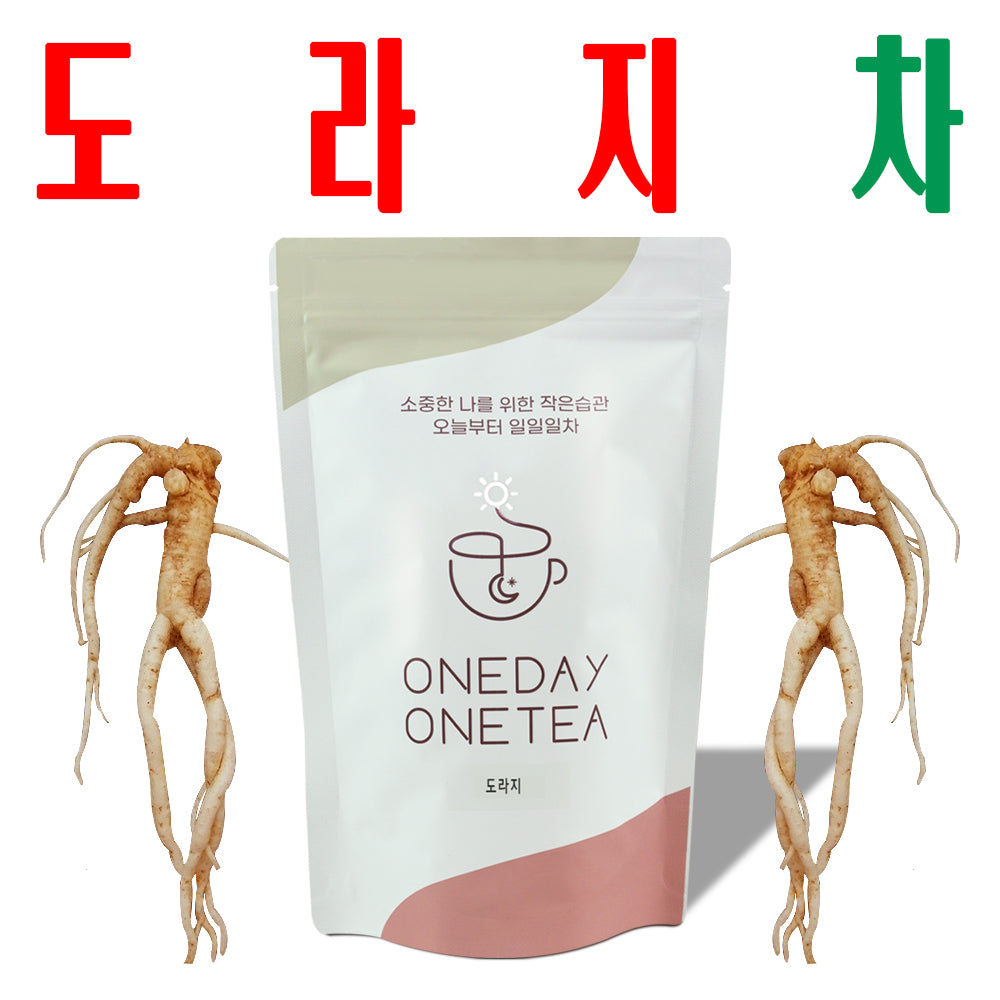
Bellflower Root Tea / Bellflower Root Tea Bags / Bellflower Root 30 Tea Bags
Bellflower Root Tea / Bellflower Root Tea Bags / Bellflower Root 30 Tea Bags
Balloon Flower/Platycodon
Balloon Flower Tea/Balloon Flower Tea Bag/Balloon Flower Tea Bag/Platycodon Tea/Platycodon Tea Bag/Platycodon Tea Bag

|
||||||||||||||||||||||||||
What is Balloon Flower Tea?Balloon flower tea is a disposable tea bag made from balloon flower (doraji) roots. Simply place the tea bag in hot water and steep for 1-2 minutes to fully enjoy the unique taste and aroma of the balloon flower. The tea has a slightly sweet and savory flavor, but also carries a subtle bitter aftertaste. The scent is the mild, signature aroma of the balloon flower. Here is an introduction to the balloon flower, the raw material for our tea. Balloon Flower (Doraji)Native to Korea, China, Japan, and the Russian Far East, the balloon flower is a common plant in nature. "Doraji" is a pure Korean name; legend has it that the name originated from people calling the flower that bloomed on the grave of a maiden who died of a broken heart after her lover left her. The name of the flower is derived from the maiden's name. Born from such a sad story, the plant also goes by various other names, such as Gil-gyeong (桔梗), Baek-yak (白藥), wild balloon flower, medicinal balloon flower, dol-gat, do-rat, gil-gyeong-chae, and go-gil-gyeong. Balloon Flower (Platycodon grandiflorus) is a perennial herb belonging to the Campanulaceae family and is used for food, health, and ornamental purposes. The flowers bloom in the summer, between July and August, and come in shades of blue-violet, white, and pink. You will most commonly see the blue-violet balloon flower. Because the petals contain anthocyanin, a red pigment, flowers grown in highly acidic soil can sometimes appear pink. Varieties with white flowers are called white balloon flowers, and those with double petals are called double balloon flowers. We have shown all three types below. |
||||||||||||||||||||||||||

|
||||||||||||||||||||||||||
|
Records of the balloon flower appear in the Shennong Ben Cao Jing, a Chinese text estimated to be over 2,000 years old. While it is unclear when the plant first arrived in our lands, it is mentioned in the Joseon Dynasty's Dongui Bogam. These historical records confirm that humans have recognized and used balloon flowers for food and health for at least two millennia. We have shown the balloon flower roots below. |
||||||||||||||||||||||||||

|
||||||||||||||||||||||||||
Culinary Balloon Flower vs. Medicinal Balloon FlowerThe terms "culinary balloon flower" and "medicinal balloon flower" were created to distinguish how the roots are used. These are not different seeds. Generally, balloon flowers are used for health purposes only after they have been planted for at least three years; thus, roots older than three years are called medicinal balloon flowers. Before reaching three years of age, the roots are tender and better suited for eating, hence they are called culinary balloon flowers. The bitter taste of the balloon flower that tantalizes our palate is truly exceptional. Sometimes the distinction is made by the shape of the root. Culinary roots are long and straight like radish roots, with fewer side branches and fine rootlets. Medicinal roots, on the other hand, have shorter main bodies, more branches, and numerous fine rootlets. The photo below shows a comparison. |
||||||||||||||||||||||||||

|
||||||||||||||||||||||||||
Composition of Balloon FlowerTypically, balloon flower roots are harvested for health purposes after at least three years of growth. To observe how the components change over time, we have provided an analysis of the components of 3-year-old versus 24-year-old balloon flower roots. This is a comparison of balloon flowers with a 21-year age difference. |
||||||||||||||||||||||||||
|
||||||||||||||||||||||||||
|
2). Analysis table of general components in 24-year-old balloon flower (Journal of the Korean Society of Agricultural Chemistry, 1997, dry matter basis) |
||||||||||||||||||||||||||
|
||||||||||||||||||||||||||
|
As shown in the table above, there is little difference in general components between 3-year and 24-year roots. While the carbohydrate content increases slightly in the 24-year-old root, there is a corresponding decrease in protein, fat, and ash. The most important component in balloon flower roots is saponin. Since saponin is a combination of sugar and carbohydrates, an increase in carbohydrates naturally leads to an increase in saponin content. Because the carbohydrate content in 24-year-old roots is about 1.5% higher than in 3-year-old roots, the saponin content naturally increases as well. From a cultivator's perspective, however, it is much more productive to harvest 3-year-old roots eight times over a 24-year period than to wait 24 years for a single harvest. The growth rate and the rate of saponin increase are rapid between years 1 and 3, but slow down significantly after year 3. For this reason, 3- to 4-year-old roots are generally used for health purposes. Here are a few important, special, and trace components of the balloon flower.
Folk Uses of Balloon FlowerHere is a brief introduction to common folk uses of the balloon flower.
Balloon flower blossoms are harvested in July-August, and the roots are harvested from autumn to early spring, either used fresh or dried. As balloon flowers are perennial plants, the roots can be harvested between spring and autumn, but they are mainly harvested between autumn and early spring because their bitter taste is stronger and the quality is superior compared to other times of the year. |
| 1). | The raw ingredients for the balloon flower tea are supplied by the Korea Medicinal Herb Association. |
| 2). | A pure tea with no preservatives, colors, or flavors added. |
| 3). | The tea bag holding the tea particles is made of biodegradable, eco-friendly fiber that can be recycled as compost. |
| 4). | The tea bag has received European certification as a food-contact material harmless to the human body. |
| 5). | The tea bag string handle is made long so that it can be steeped in a bottle or tumbler. |
| 6). | The packaging is an aluminum zipper bag, which is resistant to moisture, preserving the taste and aroma for a long time. |
| 7). | The tea has a sweet and nutty flavor with a slight acrid note. |
| Introduction |
The product supplier is Onyudam (CEO: Yoon Seong-hyeon, Jo Su-in) and the manufacturer is Hapcheon Medicinal Herb Processing Agricultural Cooperative (CEO: Baek Mun-gi). CEO Baek, who had been running a health farm with his parents for over 20 years, established the Hapcheon Medicinal Herb Processing Agricultural Cooperative in 1996, built a processing factory the following year, received the $500,000 Export Tower award for the first time in 2003, and served as the 17th-18th chairman of the Korea Medicinal Herb Association. The Hapcheon Medicinal Herb Processing Agricultural Cooperative cultivates about 60 types of health plants, including chrysanthemums, hydrangeas, mulberry, persimmon, peony, achyranthes, safflower, motherwort, omija, goji berry, cornelian cherry, astragalus, green tea, actinidia, and balloon flower in Hapcheon-eup, Hapcheon-gun, where the cooperative is located, and uses them as ingredients for health tea. The cooperative sells its produced items through domestic and international channels and supplies products to other companies through OEM manufacturing. The Hapcheon Medicinal Herb Processing Agricultural Cooperative received a Minister of Agriculture and Forestry award in 2002, registered the trademark 'Sangrime' in 2007, received ISO22000, an international food safety management certification in 2015, was registered as a venture company in the same year, obtained a patent for the balloon flower tea manufacturing method in 2017, received HACCP, a Ministry of Food and Drug Safety management certification (No. 2018-2-9156) in 2018, and received organic certification (No. 17100199) for chrysanthemum crops in 2019, establishing its status as a small yet strong business. A brief introduction to the Hapcheon Medicinal Herb Processing Agricultural Cooperative is provided below. |
|---|---|
| Name | Hapcheon Medicinal Herb Processing Agricultural Cooperative (CEO: Baek Mun-gi) |
| Address | 16 Naegok-gil, Hapcheon-eup, Hapcheon-gun, Gyeongnam |

|
|
| 010-3352-7949 |
| 1). | Place the tea bag in hot water and steep for 2-3 minutes before drinking. |
| 2). | You can drink it anytime before or after meals, but it is better to consume on an empty stomach. |
| 3). | Besides the sweet and nutty taste, there is a slight acrid note, so it is better to drink as a hot tea. |
| 4). | Store in a cool, dry place away from direct sunlight. |
| Ingredients | Balloon flower |
|---|---|
| Origin | South Korea |
| Content | Balloon flower root 100% |
| Nutritional Information | Not legally applicable |
| Sales Unit | Bag (Contains 30 tea bags inside a polyethylene bag) |
|---|---|
| Total Net Weight | 30g (1g x 30 tea bags) |
| Consumption Period | It varies by individual consumption, so it is difficult to estimate the usage period for one bag. |
| Packaging Material | Tea bag: Biodegradable fiber Plastic bag: Polyethylene |
| Packaging Size | 15cm (W) x 23cm (H) x 6.5cm (D) |
| Food Type | Tea (Single-ingredient infusion tea) |
|---|---|
| Manufacturing Date | Unable to determine as items are shipped from the supplier's cold storage, inquiries at: 02-967-8133 |
| Expiration Date | Indicated on the packaging; products with less than 1 month left until expiration from the shipping date are not sent, inquiries at: 02-967-8133 |
| Not legally applicable. |
| Not legally applicable. |
| Not applicable under the law. |
| Payment Information |
1). For bank transfer payments, you may make payment via PC banking, internet banking, phone banking, or at a bank. - The name of the depositor entered during ordering must match the name of the actual remitter, and orders not paid for within 3 days will be automatically canceled. 2). For credit card or simple payments, the payment system processes the transaction immediately, so no further action is required. |
|---|---|
| Shipping Information |
1). Shipping Method: Parcel Delivery 2). Shipping Area: Nationwide 3). Shipping Fee: Generally free, though some items may incur a fee. 4). Delivery Time: 1 to 3 days: - For payments made before 3:00 PM, delivery is expected the next day; for payments after 3:00 PM, delivery is expected the day after next. 5). Important Notes:- Additional shipping fees may apply for island regions. - For bank transfers, shipping will commence after payment is confirmed. - Delivery may be slightly delayed during holidays or due to specific circumstances with the courier company. |
| Exchanges & Returns |
1). Conditions for Exchange and Return
- Exchanges/returns are possible within 7 days of receiving the product. - If the product received differs from the displayed/advertised content, within 3 months of receipt or within 30 days from the date the discrepancy was discovered. 2). Exceptions for Exchange and Return (based on the "Act on Consumer Protection in Electronic Commerce, Etc.")- If the product is lost or damaged due to the customer's fault (excluding cases where the packaging was opened to check the product contents). - If the product value has been lost due to opening or damaging the packaging. - If the product value has significantly decreased due to the customer's use or partial consumption. - If the product value has significantly decreased to the extent that resale is difficult due to the passage of time. - If the packaging of products that can be replicated has been damaged. 3). Warranty conditions and quality standards for exchanges and returns follow the "Framework Act on Consumers."4). Important Notes: - In the event of an exchange or return due to a change of mind, the customer is responsible for the shipping costs. |
| Compensation/ Complaint/ Dispute Resolution |
Korea Fair Trade Commission's Consumer Dispute Resolution Standards |
| Terms of Service | Terms of Service (https://bit.ly/3qDTO1Q) |
Shipping Cost
Shipping Cost
1. Free Shipping [some exclusions]
2. Free shipping on orders over ₩30,000
Shipping Location
Shipping Location
Shipped from manufacturers located throughout South Korea
Shipping Policy
Shipping Policy
1. Immediate reshipment if the product is lost after dispatch
2. Immediate exchange if the received product is damaged
3. Same-day dispatch (before 12 PM) for next-day receipt
Delivery Company
Delivery Company
CJ Logistics, Logen Express, Korea Post EMS, Lotte Express, etc.
Delivery Scheduled
Delivery Scheduled
1. Purchases made before 12 PM will be received the next day.
2. Purchases made before 2 PM will be received the next day [certain items].
3. Purchases made after 12 PM/2 PM will be received two days later.
Return Policy
Return Policy
1. Returns accepted within 7 days of product receipt
2. Returns accepted within 3 months for products that differ from advertised description
3. Returns accepted within 30 days from the date the discrepancy was discovered
4. Live products are final sale and non-returnable
5. For simple returns, buyer is responsible for round-trip shipping costs
6. For returns due to seller's fault, round-trip shipping is free
Security Policy
Security Policy
Secure payments are made through world-renowned payment companies such as PayPal, Visa, and Mastercard. Your payment information will not be shared with any third parties.
Privacy Policy
Privacy Policy
Your personal information collected for payment and delivery will be securely protected during delivery and discarded after delivery is complete.