Shipping Cost
Shipping Cost
1. Free Shipping [some exclusions]
2. Free shipping on orders over ₩30,000
Shipping Location
Shipping Location
Shipped from manufacturers located throughout South Korea
Shipping Policy
Shipping Policy
1. Immediate reshipment if the product is lost after dispatch
2. Immediate exchange if the received product is damaged
3. Same-day dispatch (before 12 PM) for next-day receipt
Delivery Company
Delivery Company
CJ Logistics, Logen Express, Korea Post EMS, Lotte Express, etc.
Delivery Scheduled
Delivery Scheduled
1. Purchases made before 12 PM will be received the next day.
2. Purchases made before 2 PM will be received the next day [certain items].
3. Purchases made after 12 PM/2 PM will be received two days later.
Return Policy
Return Policy
1. Returns accepted within 7 days of product receipt
2. Returns accepted within 3 months for products that differ from advertised description
3. Returns accepted within 30 days from the date the discrepancy was discovered
4. Live products are final sale and non-returnable
5. For simple returns, buyer is responsible for round-trip shipping costs
6. For returns due to seller's fault, round-trip shipping is free
Security Policy
Security Policy
Secure payments are made through world-renowned payment companies such as PayPal, Visa, and Mastercard. Your payment information will not be shared with any third parties.
Privacy Policy
Privacy Policy
Your personal information collected for payment and delivery will be securely protected during delivery and discarded after delivery is complete.
Noni Tea / Noni Tea Bag / Noni Tea Bags (30 count)
Noni Tea / Noni Tea Bag / Noni Tea Bags (30 count)
Noni
Noni Tea/Noni Tea Bag/Noni Tea Bag

|
||||||||||||||||||||||||||||||||||||||||||||||||||
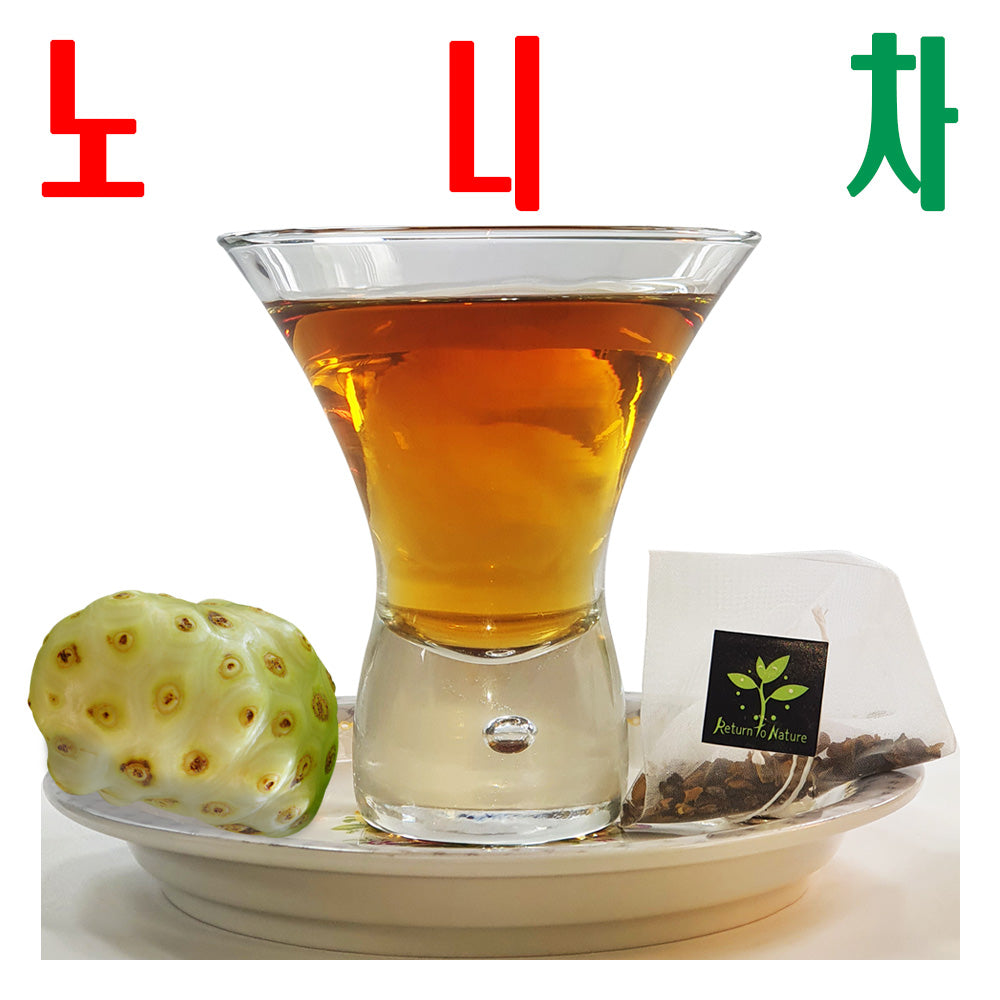
What is Noni Tea?Noni tea is a disposable tea bag made from noni fruit. Simply place the tea bag in hot water and steep for 1-2 minutes to fully enjoy the taste and aroma of noni. While there is a subtle sourness, the distinct taste and aroma of the noni fruit itself are strongly evident. You can enjoy the taste and aroma of noni even more deeply by drinking the tea cold. We would like to introduce noni, the raw material for our noni tea. NoniNoni is a perennial plant with evergreen leaves that grows in tropical and subtropical regions, and cannot be found in temperate regions like Korea. The origin of noni is believed to be Southeast Asia, India, or the South Pacific islands; however, genetic analysis suggests that Micronesia in the South Pacific is the most likely place of origin. Noni has been used by the indigenous people of its native regions for food, health, and industrial purposes for a very long time. In the Ayurveda, an ancient Indian medical text, noni is recorded as 'Ashuka' (which means longevity in Sanskrit). Ancient Indians always carried noni with them when embarking on sea voyages. Furthermore, Indians regarded noni as a sacred tree. Based on these historical records, modern Indians claim that India is the place of origin for noni. Two thousand years ago, Southeast Asian people also valued noni highly, ranking it second on their list of 12 essential items to carry when setting out on sea expeditions. This indicates that humanity has known and utilized noni for at least 2,000 years. Due to its appearance, noni is nicknamed the "Indian Mulberry," "Beach Mulberry" because it primarily grows along the coast, and "Cheese Fruit" due to the cheese-like smell produced by the fruit. Folk traditions have utilized the flowers, seeds, fruits, leaves, stems, and roots of noni for health purposes. Today, it is commercialized in various forms such as raw juice, blended juice, decoctions, powder, tea, pills, lotions, soaps, oils, and skin creams, and is sold in over 70 countries. Noni and Bajitian (Morinda officinalis)In plant taxonomy, noni is a tree belonging to the genus Morinda. The Morinda genus consists of 80 species. There is a tree famous since ancient times in relation to men called Bajitian (巴戟天), which also belongs to the Morinda genus. While some people mistakenly perceive Bajitian and noni as the same tree, they are not the same. Bajitian is a name that originally referred to the dried root but is used as the name of the tree today. Bajitian is a tree that grows in the mountainous regions of southern China, such as Guangdong, Guangxi, Fujian, and Hainan provinces. There is a tree that grows mainly along the coast in areas where Bajitian grows, which has fruit and flowers similar to those of Bajitian; the Chinese call this Haibaji (海巴戟) or "Sea Bajitian." This Haibaji entered Hawaii via the Polynesian region of the Pacific 1,500 years ago and is known today as Noni. Haibaji (noni) and Bajitian are closely related, like cousins in human terms, but they are different species, and their appearance and uses differ. Below are photos of the fruits of an under-ripe noni and a fully ripe Bajitian. |
||||||||||||||||||||||||||||||||||||||||||||||||||

|
||||||||||||||||||||||||||||||||||||||||||||||||||
Why Noni is FamousIn 2003, noni was classified as a "Novel Food" by the European Union. "Novel Food" is a food classification term in Europe referring to foods that Europeans had little experience eating before 1997 or were newly developed using innovative techniques rather than traditional ones. The reason the EU classified noni as a novel food is because, although it has been consumed for 2,000 years in regions outside of Europe, the duration of consumption experience by Europeans is relatively short. What is the background for why Noni, a novel food, has become so famous that it is manufactured and sold by over 300 companies in more than 70 countries around the world, including the United States, China, Germany, and Japan? In 1954, a famous French journal published content stating that noni is highly beneficial for health. Subsequently, in the 1970s, Dr. Ralph Heinicke, who was studying enzymes in Hawaii, introduced the pro-xeronine/xeronine enzyme theory to explain the utility of the noni fruit and obtained a patent related to it in 1981. After 1981, Dr. Ralph Heinicke wrote extensively about noni. In 1996, food scientists John Wadsworth and Stephen Story founded a company called 'Tahitian Noni International and Morinda Bioactives,' with Dr. Ralph Heinicke serving as an advisory board member, and began selling noni juice worldwide. It is believed that this company is responsible for noni becoming globally famous. It is said that in 2014, the annual global sales of noni products reached 1.4 trillion won, and this company reportedly accounted for about 40% of those sales. Since the 2000s, noni has been a plant used for both food and health purposes, with research into its benefits being actively conducted in both the East and the West. Noni CompositionBelow is a general analysis table for Hawaiian noni fruit powder. We are providing this powder analysis table because examining the components of the powder allows one to understand the composition of the noni fruit itself. |
||||||||||||||||||||||||||||||||||||||||||||||||||
|
||||||||||||||||||||||||||||||||||||||||||||||||||
|
The above content ratios are approximations. Looking at the composition of the powder, there is nothing particularly unusual compared to general fruits, but the ash content is relatively rich. This indicates that it is rich in the minerals that make up the ash. Below is the general analysis table for noni juice. |
||||||||||||||||||||||||||||||||||||||||||||||||||
|
||||||||||||||||||||||||||||||||||||||||||||||||||
|
The general content ratio of noni juice is not significantly different from that of noni powder. Noni juice is rich in minerals and also relatively rich in protein. About 200 substances have been found in the fruit, seeds, stems, and roots of noni, and here we introduce a few of the trace, unique, and important components contained in the fruit and seeds.
Traditional Uses of NoniHere is a brief introduction to the traditional uses of noni in Southeast Asia, India, and the Pacific Islands.
|
| 1). | The noni tea raw material is supplied by the Korea Herbal Medicine Association. |
| 2). | It is a pure tea with no preservatives, colors, or flavors, and nothing else added. |
| 3). | The tea bag containing the tea particles is made of biodegradable, eco-friendly fiber that can be recycled as compost. |
| 4). | The tea bag holding the tea particles has received European certification as a food-contact material harmless to humans. |
| 5). | The tea bag handle string has been made long enough for brewing in a bottle or tumbler. |
| 6). | The packaging is an aluminum zipper bag, making it resistant to moisture and preserving the taste and aroma for a long time. |
| 7). | The tea has a slight sour taste and a strong, unique noni flavor. It is very mild, quite different from fresh fruit juice. |
| Intro |
The product supplier is Onyudam (CEO: Yoon Sung-hyun, Jo Su-in), and the manufacturer is Hapcheon Herbal Processing Farming Association (CEO: Baek Moon-ki). CEO Baek managed a health food farm for 20 years with his parents before establishing the Hapcheon Herbal Processing Farming Association in 1996, building a processing plant the following year, winning the $500,000 Export Tower award for the first time in 2003, and serving as the 17th-18th president of the Korea Herbal Medicine Association. The Hapcheon Herbal Processing Farming Association cultivates over 60 species of healthy plants in Hapcheon-eup, Hapcheon-gun, where the association is located, including chrysanthemum, hydrangea, mulberry, persimmon, peony, achyranthes, safflower, motherwort, omija, matrimony vine, cornelian cherry, milk vetch root, green tea, silver vine, and bellflower, using them as raw materials for healthy tea. The association sells its products through domestic and international channels and also supplies products to other companies via OEM manufacturing. The Hapcheon Herbal Processing Farming Association received the Minister of Agriculture and Forestry Award in 2002, registered the trademark 'Sanggurime' in 2007, received the international food safety certification ISO22000 in 2015, was registered as a venture company in the same year, patented a bellflower tea manufacturing method in 2017, received HACCP certification from the Ministry of Food and Drug Safety (No. 2018-2-9156) in 2018, and received organic certification (No. 17100199) for chrysanthemum crops in 2019, solidifying its status as a strong small business. A brief introduction to the Hapcheon Herbal Processing Farming Association follows below. |
|---|---|
| Name | Hapcheon Herbal Processing Farming Association (CEO: Baek Moon-ki) |
| Address | 16, Naegok-gil, Hapcheon-eup, Hapcheon-gun, Gyeongnam |

|
|
| 010-3352-7949 |
| 1). | Place the tea bag in hot water and let it steep for 2-3 minutes. |
| 2). | You can drink it at any time, before or after a meal, but it is better to consume on an empty stomach. |
| 3). | Drinking it as a cold tea allows you to enjoy the unique taste and aroma of noni more deeply. |
| 4). | Store in a cool, dry place away from direct sunlight. |
| Ingredients | Noni |
|---|---|
| Country of Origin | Vietnam |
| Composition | Noni fruit 100% |
| Nutritional Info | Not applicable |
| Sales Unit | Bag (contains 30 tea bags inside a polyethylene bag) |
|---|---|
| Total Net Content | 30g (1g x 30 tea bags) |
| Consumption Period | As it depends on individual usage, it is difficult to calculate the consumption period for one bag. |
| Packaging Material | Tea bag: Biodegradable fiber Plastic bag: Polyethylene |
| Packaging Size | Width 15cm x Length 23cm x Thickness 6.5cm |
| Food Type | Tea (Single-ingredient infusion tea) |
|---|---|
| Manufacturing Date | Manufacturing date cannot be determined as products are shipped from the supplier's cold storage; for verification, call: 02-967-8133 |
| Expiration Date | Indicated on the outer packaging; products with less than 1 month of shelf life remaining from the shipment date are not sent; for verification, call: 02-967-8133 |
| Not legally applicable. |
| Not legally applicable. |
| Not legally applicable. |
| Payment Information |
1). For bank transfers, payments can be made via PC banking, internet banking, phone banking, or at a bank. - The name of the depositor must match the name entered during the order; orders not paid within 3 days will be automatically canceled. 2). For card or easy payments, the system processes the payment immediately, so no further action is required. |
|---|---|
| Delivery Information |
1). Delivery Method: Courier service 2). Delivery Region: Nationwide 3). Delivery Fee: Generally free, but some paid options apply 4). Delivery Period: 1–3 days: - If paid before 3:00 PM, you can receive the product the following day; if paid after 3:00 PM, you can receive it the day after next. 5). Notes:- Additional shipping fees may apply to island regions. - For bank transfers, shipping occurs after confirmation of payment. - Delivery may be slightly delayed during holidays or due to special circumstances at the courier service. |
| Exchange and Returns |
1). Cases for Exchange and Returns - Exchanges/returns are possible within 7 days of receiving the product. - If the received product differs from the display or advertisement, within 3 months of receipt, or within 30 days of discovering such fact. 2). Cases where Exchange and Returns are NOT possible (per the "Consumer Protection Act in Electronic Commerce")- Loss or damage to the product due to the customer's fault. (Excluding cases where packaging was damaged to verify product content) - Loss of product value due to opening the package or damaging the packaging. - Significant reduction in product value due to customer usage or partial consumption. - Significant reduction in product value due to the passage of time, making resale difficult. - Damaging the packaging of products that can be replicated. 3). Warranty conditions and quality assurance standards follow the "Framework Act on Consumers".4). Notes: - If you are exchanging or returning due to a change of mind, you are responsible for the shipping costs. |
| Damage Compensation/ Complaints/ Dispute Resolution Standards |
Consumer Dispute Resolution Standards by the Fair Trade Commission |
| Terms of Service | Terms of Use (https://bit.ly/3qDTO1Q) |
Shipping Cost
Shipping Cost
1. Free Shipping [some exclusions]
2. Free shipping on orders over ₩30,000
Shipping Location
Shipping Location
Shipped from manufacturers located throughout South Korea
Shipping Policy
Shipping Policy
1. Immediate reshipment if the product is lost after dispatch
2. Immediate exchange if the received product is damaged
3. Same-day dispatch (before 12 PM) for next-day receipt
Delivery Company
Delivery Company
CJ Logistics, Logen Express, Korea Post EMS, Lotte Express, etc.
Delivery Scheduled
Delivery Scheduled
1. Purchases made before 12 PM will be received the next day.
2. Purchases made before 2 PM will be received the next day [certain items].
3. Purchases made after 12 PM/2 PM will be received two days later.
Return Policy
Return Policy
1. Returns accepted within 7 days of product receipt
2. Returns accepted within 3 months for products that differ from advertised description
3. Returns accepted within 30 days from the date the discrepancy was discovered
4. Live products are final sale and non-returnable
5. For simple returns, buyer is responsible for round-trip shipping costs
6. For returns due to seller's fault, round-trip shipping is free
Security Policy
Security Policy
Secure payments are made through world-renowned payment companies such as PayPal, Visa, and Mastercard. Your payment information will not be shared with any third parties.
Privacy Policy
Privacy Policy
Your personal information collected for payment and delivery will be securely protected during delivery and discarded after delivery is complete.