Shipping Cost
Shipping Cost
1. Free Shipping [some exclusions]
2. Free shipping on orders over ₩30,000
Shipping Location
Shipping Location
Shipped from manufacturers located throughout South Korea
Shipping Policy
Shipping Policy
1. Immediate reshipment if the product is lost after dispatch
2. Immediate exchange if the received product is damaged
3. Same-day dispatch (before 12 PM) for next-day receipt
Delivery Company
Delivery Company
CJ Logistics, Logen Express, Korea Post EMS, Lotte Express, etc.
Delivery Scheduled
Delivery Scheduled
1. Purchases made before 12 PM will be received the next day.
2. Purchases made before 2 PM will be received the next day [certain items].
3. Purchases made after 12 PM/2 PM will be received two days later.
Return Policy
Return Policy
1. Returns accepted within 7 days of product receipt
2. Returns accepted within 3 months for products that differ from advertised description
3. Returns accepted within 30 days from the date the discrepancy was discovered
4. Live products are final sale and non-returnable
5. For simple returns, buyer is responsible for round-trip shipping costs
6. For returns due to seller's fault, round-trip shipping is free
Security Policy
Security Policy
Secure payments are made through world-renowned payment companies such as PayPal, Visa, and Mastercard. Your payment information will not be shared with any third parties.
Privacy Policy
Privacy Policy
Your personal information collected for payment and delivery will be securely protected during delivery and discarded after delivery is complete.
Pu-erh Tea / Yunnan Pu-erh Tea / Pu-erh Tea Bags 30 count
Pu-erh Tea / Yunnan Pu-erh Tea / Pu-erh Tea Bags 30 count
Pu-erh Tea/Tea/Chinese Tea
Yunnan Tea/Pu-erh Tea/Dark Tea/Post-fermented Tea/Pu-erh Tea Bag/Yunnan Pu-erh Tea/Large-leaf Tea
 |
||||||||||||||||||||
What is Pu-erh tea?Pu-erh tea, along with marble and Panax notoginseng, is one of the three treasures of Yunnan Province, China. It is a highly renowned and precious tea both in China and worldwide. This product consists of Pu-erh tea imported from China that has been processed to remove impurities and foreign substances, finely ground, and packed into disposable tea bags. Therefore, by placing a tea bag in hot water and steeping it for about a minute, you can enjoy the deep taste and subtle aroma of Pu-erh tea. You may steep it 1-2 more times. Here is a brief introduction to the tea tree, the raw material for Pu-erh tea, and Pu-erh tea itself. Tea TreeThe tea tree is the raw material for Pu-erh tea. The Korean term 'Ilsangdabansa' (daily tea and rice), meaning something that happens every day, shows that our ancestors frequently drank tea. The origin of the tea tree is estimated to be near the source of the Irrawaddy River (between Sichuan Province and Tibet, China), at the eastern end of the Himalayas and north of Myanmar. It is estimated that the tea tree spread from its origin westward to Assam, India; eastward across the southern border of China to Zhejiang Province; and southward to southern Vietnam. The history of tea is very deep, as indicated by the legend that Shennong, a mythical figure in China, was the first to use tea, and records show that King Wu of the Zhou Dynasty received tea from Yunnan as tribute around 1000 BC. Below are the leaves, flowers, and fruits of the tea tree. |
||||||||||||||||||||
 |
||||||||||||||||||||
Types of TeaTea can be subdivided into as many as 3,000 varieties, and the classification methods are very diverse. In terms of classification, Pu-erh tea falls under green tea, dark tea (heicha), naturally oxidized tea, and post-fermented tea. Here is a brief introduction to four methods of classifying tea. 1). Based on tea leaf shape: Loose tea, compressed tea, matcha, raw tea Tea leaves contain chlorophyll, which gives them a green color, but when leaves are plucked and dried, the chlorophyll is oxidized and destroyed, causing the green color to disappear and turn brown. Oxidative enzymes that destroy chlorophyll are sensitive to heat and are destroyed when heated. If the chlorophyll-oxidizing enzyme is destroyed, the chlorophyll is preserved without being destroyed. When tea leaves are heated, the oxidative enzyme is destroyed, stopping chlorophyll oxidation, allowing the green color to be maintained and extracted when boiled in water. This is called green tea. Conversely, if chlorophyll oxidation is promoted to completely destroy the chlorophyll, the leaves turn black and produce a red color when boiled. This is called black tea. Fermented TeaPu-erh tea is a fermented tea. Fermented tea is manufactured by controlling the organic decomposition process caused by enzymes or microorganisms within the tea leaves. As many substances are created during the tea leaf fermentation process, the color, taste, and aroma of the tea differ before and after fermentation. When tea leaves are fermented, bitter and astringent components are reduced, while sweet, yellow/red components increase. Well-fermented tea has a bright liquor color and a sweet, refreshing taste. Because Pu-erh tea undergoes fermentation in storage after it is produced, people call it post-fermented tea. Dark TeaPu-erh tea is a dark tea (Heicha). Compared to the light color of black tea liquor, Pu-erh tea is called dark tea (Heicha: 黑茶 = Black 黑) because the color is darker. During the production process of Pu-erh tea, there is a step to stop tea leaf oxidation and thus stop the destruction of chlorophyll. Therefore, a lot of green color remains. In the Pu-erh tea production process, new yellow theaflavin and red thearubigin components are created. Because the green color of the chlorophyll remaining until the end of the production process blends with the newly created yellow theaflavins and red thearubigins, it creates a reddish-brown or chestnut-brown color, which is why it looks darker than the red color of black tea. Below are the colors of green tea, black tea, and Pu-erh tea. |
||||||||||||||||||||
 |
||||||||||||||||||||
Pu-erh TeaPu-erh tea (普洱茶) is a fermented tea made from Yunnan large-leaf tea leaves; 'Pu-erh' originates from the government office name Pu-erh (普洱) that existed in the past. Even today, there is a Pu-erh City (普洱市) in the region where Pu-erh tea is produced. Pu-erh tea was the finest tea in China, offered to the Chinese imperial court of the Qing Dynasty for 200 years. In the days when tea, pottery, and silk were China's three major exports, the tea sent as a gift to the King of England from China was Pu-erh tea. The quality and price of Pu-erh tea are determined by the quality of the raw tea leaves, the manufacturing method, and the storage period. Because Pu-erh tea originally referred to tea whose gathering and distribution center was Pu-erh, it was a general term referring to all teas, including green tea and black tea, but now it has become a name for a specific type of tea referring to dark tea made by post-fermenting Yunnan large-leaf tea leaves. The affordable Pu-erh tea that the general public tastes today is tea made according to the standardized modern fast-production methods of the 1970s, which is a mix of cultivated and wild tea leaves. Pu-erh tea has the advantage of supplementing the disadvantages of black tea, such as the bitter taste found in green/black tea and the complete destruction of vitamins due to oxidation, while creating a deep taste and aroma with new components produced during fermentation. Pu-erh tea enthusiasts place very high value on the deep taste and aroma felt from fermented tea. Pu-erh tea has a smooth taste without bitterness, but contains a lot of caffeine and catechin, making it good as a coffee substitute, a health tea, and because of its great fame, a suitable social tea. Types of Pu-erh TeaPu-erh tea is divided into loose tea and compressed tea according to the shape of the tea grains. Loose tea (散茶 = scattered 散) refers to tea where the tea leaf grains are not clustered but scattered when the appearance of the tea is completed. Compressed tea (緊壓茶 = tight 緊, press 壓) refers to tea made by steaming loose tea and then putting it into various molding frames and pressing it into shapes like cakes [->Bingcha (餠茶)], mushrooms [->Jincha (緊茶)], bird nests [->Tuocah (沱茶)], and bricks [->Zhuan-cha (磚茶)]. Compressed tea is convenient for transport and storage because the tea leaves are compressed, reducing volume. Below are pictures of loose tea and compressed tea (cake tea). |
||||||||||||||||||||
 |
||||||||||||||||||||
|
Pu-erh tea is divided into raw tea and ripe tea according to the fermentation situation. Raw tea (生茶) refers to tea leaves left in the shade, pan-fried in a wok, rolled by machine or hand, and then sun-dried. This raw tea is unfermented tea and its taste is close to green tea. This raw tea is aged by keeping it in storage and controlling the temperature/humidity to induce natural fermentation by microorganisms. Tea aged in this way is called ripe tea (熟茶). There is a modern fast-fermentation process to make ripe tea. This is a process of sprinkling water on raw tea, adjusting the temperature/humidity suitable for fermentation, and mixing it while fermenting for about a month to ensure even fermentation. This process was developed and standardized in Guangdong Province. Most Pu-erh tea currently on the market is ripe tea made through this fast fermentation. The longer the storage period (aging period) of ripe tea in the warehouse, the deeper the taste. Among the Pu-erh teas manufactured in the past, there are those called "Hao" (號) grade, "Yin" (印) grade, and "Shu" (數) grade; these are old, and because they cost hundreds of millions or billions of won, they are called antique Pu-erh tea. Depending on the age of the tea tree, the raw material, tea over 300 years old is called Dan-zhu tea (單株茶), over 100 years is Gu-shu tea (古樹茶), 60-100 years is Zhong-shu tea (中樹茶), and less than 60 years is Xiao-shu tea (小樹茶). Tea made from leaves of tea trees grown in terraced fields created by cutting mountains is called Tai-di tea (臺地茶). Why Pu-erh tea is famousAmong teas made from tea trees, the most famous tea in the world is black tea, which accounts for 70% of global tea production. But why did Pu-erh tea attract the attention of the world? The primary factor in Pu-erh tea becoming world-famous is the well-being wind that started blowing in the 1980s. To well-being enthusiasts living with the motto of living a long life with a healthy body and mind, the gallic acid and catechins abundant in Pu-erh tea, as well as its taste and aroma, felt attractive. When the global well-being wind blew, Chinese merchants in Hong Kong and Taiwan rode the well-being wind, re-awakening the fame of Pu-erh tea that had disappeared with the fall of the Qing Dynasty, converting the value of tea into gold value. Chinese merchants have brilliant sales tactics that can make a 2kg bundle of antique Pu-erh tea sell for 2 billion won. I think overseas Chinese merchants spread across the world are the second factor that made Pu-erh tea world-famous. There was also a time when there was a great Pu-erh tea trend in Korea. Components of tea leavesBelow is the proximate composition table of tea leaves from data by the National Institute of Agricultural Sciences, Rural Development Administration. Dry matter basis means the content ratio was determined excluding moisture. Analysis table of tea leaf proximate composition (Rural Development Administration, 2013, dry matter basis, 388kcal/100g tea leaves with 0.9% moisture) |
||||||||||||||||||||
|
||||||||||||||||||||
Components of Pu-erh teaBelow is the proximate composition table of Pu-erh tea liquid from data by the National Institute of Agricultural Sciences, Rural Development Administration. The data below is for components contained in tea liquid, and while it is not a precise figure, it is an approximate value that can roughly estimate what is most dissolved in the tea liquid. Here, dry matter basis means the content ratio was determined excluding water completely. Since there is no dietary fiber in tea liquid, the content ratio of protein and ash appears very high. Analysis table of Pu-erh tea liquid proximate composition (Rural Development Administration, 2016, dry matter basis) |
||||||||||||||||||||
|
||||||||||||||||||||
|
Tea leaves are rich in protein and have very high caloric content. The calorie content of tea leaves is almost equivalent to that of rice. The high caloric content of tea leaves means that, in addition to protein, they contain a large amount of polysaccharides within their carbohydrates. Furthermore, it can be noted that Puer tea contains a high amount of total sugars (sucrose, glucose, fructose, etc.) that were not originally present in the tea leaves, which is because polysaccharides are broken down into monosaccharides and disaccharides during the tea fermentation process. Below are some of the key components, special components, and trace elements found in tea leaves.
|
||||||||||||||||||||
| 1). | The Puer tea raw material is supplied by the Korea Herbal Medicine Association. |
| 2). | It is a pure tea with no preservatives, no artificial colors, and no artificial fragrances; nothing else has been added. |
| 3). | The tea bag containing the tea particles is an eco-friendly fiber that is biodegradable and can be recycled as compost. |
| 4). | The tea bag containing the tea particles has received European certification as a food-contact material harmless to the human body. |
| 5). | The tea bag string has been made long so that the tea can be steeped in a bottle or tumbler. |
| 6). | The packaging bag is an aluminum zipper bag, which is resistant to moisture, allowing the taste and aroma to be preserved for a long time. |
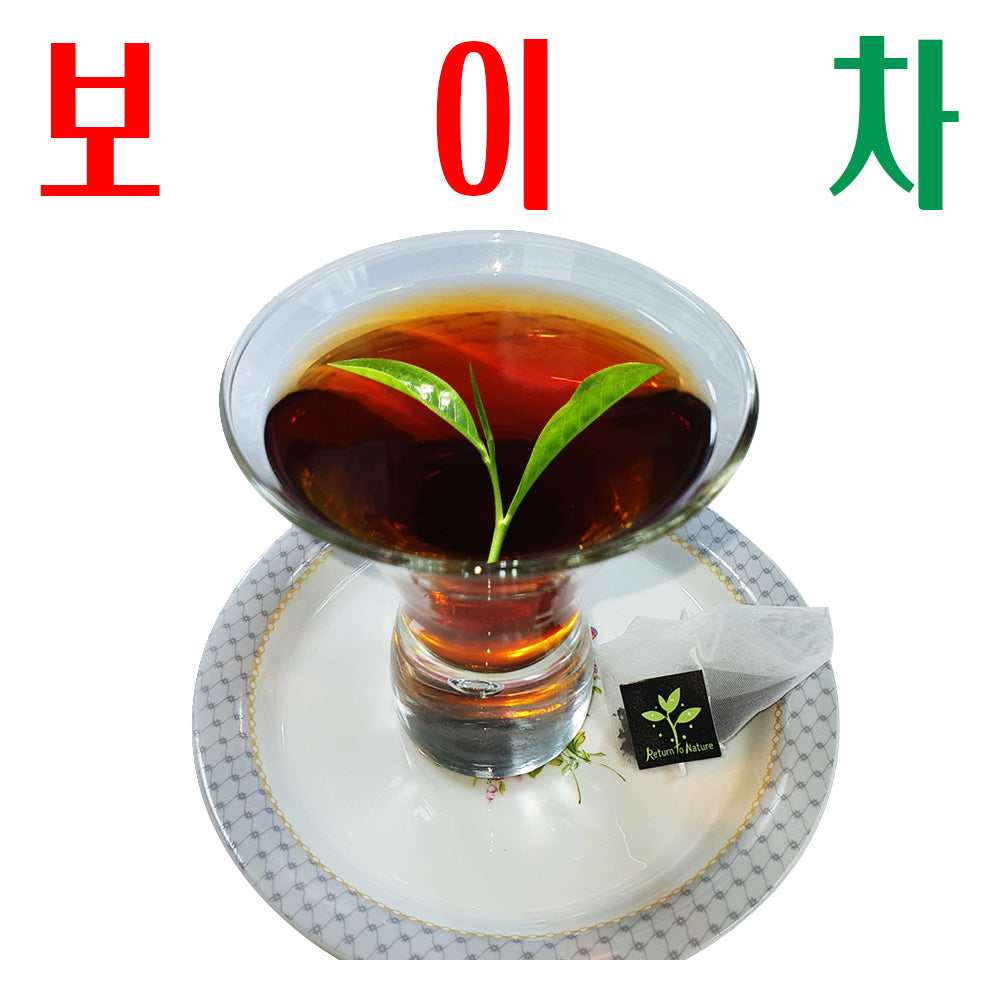
| 7). | The soft and clean taste, subtle aroma, and the reddish-brown tea infusion color characteristic of Puer tea are truly excellent. |
| Introduction |
The product supplier is Onyudam (CEO: Yoon Sung-hyun, Jo Soo-in) and the manufacturer is Hapcheon Herbal Medicine Processing Farming Association Co., Ltd. (CEO: Baek Moon-ki). While operating a medicinal herb farm for over 20 years with his parents, CEO Baek established the Hapcheon Herbal Medicine Processing Farming Association in 1996, built a processing factory the following year, received the $500,000 Export Tower award for the first time in 2003, and served as the 17th-18th chairman of the Korea Herbal Medicine Association. The Hapcheon Herbal Medicine Processing Farming Association cultivates about 60 types of medicinal plants, including chrysanthemum, hydrangea, mulberry, persimmon, peony, achyranthes, safflower, motherwort, schisandra, goji berry, cornelian cherry, milk vetch root, green tea, actinidia, and balloon flower in Hapcheon-eup, Hapcheon-gun, where the association is located, and uses them as ingredients for healthy tea. Hapcheon Herbal Medicine Processing Farming Association sells its products through domestic and international distribution channels and also supplies products to other companies through OEM manufacturing. Hapcheon Herbal Medicine Processing Farming Association received the Minister of Agriculture and Forestry Award in 2002, registered the trademark 'Sangrime' in 2007, received ISO22000 certification (an international food safety standard) in 2015, was registered as a venture company in the same year, obtained a patent for the balloon flower tea manufacturing method in 2017, received HACCP certification (No. 2018-2-9156) from the Ministry of Food and Drug Safety in 2018, and received organic certification (No. 17100199) for chrysanthemum crops in 2019, thus establishing itself as a small but strong company. A brief introduction to the Hapcheon Herbal Medicine Processing Farming Association is provided below. |
|---|---|
| Name | Hapcheon Herbal Medicine Processing Farming Association Co., Ltd. (CEO: Baek Moon-ki) |
| Address | 16, Naegok-gil, Hapcheon-eup, Hapcheon-gun, Gyeongnam |
 |
|
| 010-3352-7949 |
| 1). | Place a tea bag in hot water and steep for 1-2 minutes before drinking. |
| 2). | You can drink it at any time before or after meals, but as the tea is high in caffeine, those with weak stomachs should drink it after meals. |
| 3). | Since the moldy smell that can occur in fermented tea has been removed, you can drink the first infusion as is. | 4). | After drinking the first infusion, you can steep the same tea bag 1-2 more times. |
| 5). | Store in a cool, dry place away from direct sunlight. |
| Ingredients | Tea leaves |
|---|---|
| Country of Origin | Republic of Korea |
| Component Content | Puer tea 100% (Chinese tea leaves 100%) |
| Nutritional Information | Not legally applicable |
| Sales Unit | Bag (polyethylene bag contains 30 tea bags) |
|---|---|
| Total Content | 30g (1g x 30 tea bags) |
| Consumption Period | It is difficult to estimate the consumption period for 1 bag as it depends on how you drink it. |
| Packaging Material | Tea bag: Biodegradable fiber Plastic bag: Polyethylene |
| Packaging Size | Width 15cm x Length 23cm x Thickness 6.5cm |
| Food Type | Tea (Single-steeped tea) |
|---|---|
| Manufacturing Date | Manufacturing date cannot be determined as products are shipped from the supplier's cold storage; for verification, call: 02-967-8133 |
| Expiration Date | Indicated on the packaging; products with less than 1 month left until the expiration date at the time of shipment are not sent; for verification, call: 02-967-8133 |
| Not applicable legally. |
| Not applicable legally. |
| Not applicable legally. |
| Payment Info | 1). For bank transfer payments, the purchase price can be remitted via PC banking, internet banking, telephone banking, or at a bank. - The depositor's name entered at the time of order must match the name of the person making the transfer; orders not paid within 3 days will be automatically canceled. 2). For credit card or simple payments, the payment system processes the transaction immediately, so no additional steps are required. |
|---|---|
| Shipping Info | 1). Shipping method: Parcel service 2). Shipping area: Nationwide 3). Shipping fee: Generally free, but some charges may apply 4). Delivery time: 1 to 3 days: - Orders paid before 3 PM will be received the next day, and those after 3 PM the day after next. 5). Notes:- Additional shipping fees may apply for island regions. - For bank transfer payments, shipping will occur after your payment is confirmed. - Delivery may be delayed during holidays or due to special circumstances at the courier service. |
| Exchange/Return | 1). Eligible for exchange/return: - Exchange/return is possible within 7 days of receiving the product. - If the product received differs from the description/advertisement, within 3 months of receipt or 30 days of discovering the discrepancy. 2). Ineligible for exchange/return (exceptions to the right of withdrawal per the "E-Commerce Act"):- If the product is lost/damaged due to the customer's fault (except when packaging is opened to check the contents). - If the product has been opened or the packaging is damaged, resulting in the loss of product value. - If the value of the product has significantly decreased due to customer use or partial consumption. - If the value of the product has significantly decreased over time, making resale difficult. - If the packaging of reproducible products, etc., is damaged. 3). Warranty conditions and quality assurance standards for exchange and return follow the "Framework Act on Consumers."4). Notes: - If you wish to exchange or return an item due to a change of mind, you must bear the shipping costs. |
| Damage Compensation/ Complaint/ Dispute Resolution |
KFTC Consumer Dispute Resolution Standards |
| Terms and Conditions | Terms of Use(https://bit.ly/3qDTO1Q) |
Shipping Cost
Shipping Cost
1. Free Shipping [some exclusions]
2. Free shipping on orders over ₩30,000
Shipping Location
Shipping Location
Shipped from manufacturers located throughout South Korea
Shipping Policy
Shipping Policy
1. Immediate reshipment if the product is lost after dispatch
2. Immediate exchange if the received product is damaged
3. Same-day dispatch (before 12 PM) for next-day receipt
Delivery Company
Delivery Company
CJ Logistics, Logen Express, Korea Post EMS, Lotte Express, etc.
Delivery Scheduled
Delivery Scheduled
1. Purchases made before 12 PM will be received the next day.
2. Purchases made before 2 PM will be received the next day [certain items].
3. Purchases made after 12 PM/2 PM will be received two days later.
Return Policy
Return Policy
1. Returns accepted within 7 days of product receipt
2. Returns accepted within 3 months for products that differ from advertised description
3. Returns accepted within 30 days from the date the discrepancy was discovered
4. Live products are final sale and non-returnable
5. For simple returns, buyer is responsible for round-trip shipping costs
6. For returns due to seller's fault, round-trip shipping is free
Security Policy
Security Policy
Secure payments are made through world-renowned payment companies such as PayPal, Visa, and Mastercard. Your payment information will not be shared with any third parties.
Privacy Policy
Privacy Policy
Your personal information collected for payment and delivery will be securely protected during delivery and discarded after delivery is complete.