Shipping Cost
Shipping Cost
1. Free Shipping [some exclusions]
2. Free shipping on orders over ₩30,000
Shipping Location
Shipping Location
Shipped from manufacturers located throughout South Korea
Shipping Policy
Shipping Policy
1. Immediate reshipment if the product is lost after dispatch
2. Immediate exchange if the received product is damaged
3. Same-day dispatch (before 12 PM) for next-day receipt
Delivery Company
Delivery Company
CJ Logistics, Logen Express, Korea Post EMS, Lotte Express, etc.
Delivery Scheduled
Delivery Scheduled
1. Purchases made before 12 PM will be received the next day.
2. Purchases made before 2 PM will be received the next day [certain items].
3. Purchases made after 12 PM/2 PM will be received two days later.
Return Policy
Return Policy
1. Returns accepted within 7 days of product receipt
2. Returns accepted within 3 months for products that differ from advertised description
3. Returns accepted within 30 days from the date the discrepancy was discovered
4. Live products are final sale and non-returnable
5. For simple returns, buyer is responsible for round-trip shipping costs
6. For returns due to seller's fault, round-trip shipping is free
Security Policy
Security Policy
Secure payments are made through world-renowned payment companies such as PayPal, Visa, and Mastercard. Your payment information will not be shared with any third parties.
Privacy Policy
Privacy Policy
Your personal information collected for payment and delivery will be securely protected during delivery and discarded after delivery is complete.
Rock tripe/ Umbilicaria esculenta/ Umbilicaria esculenta 100g
Rock tripe/ Umbilicaria esculenta/ Umbilicaria esculenta 100g
Rock Tripe/Seogi Mushroom
Dried Rock Tripe/Dried Seogi Mushroom
 |
||||||||||||||||||||||||||||||||||
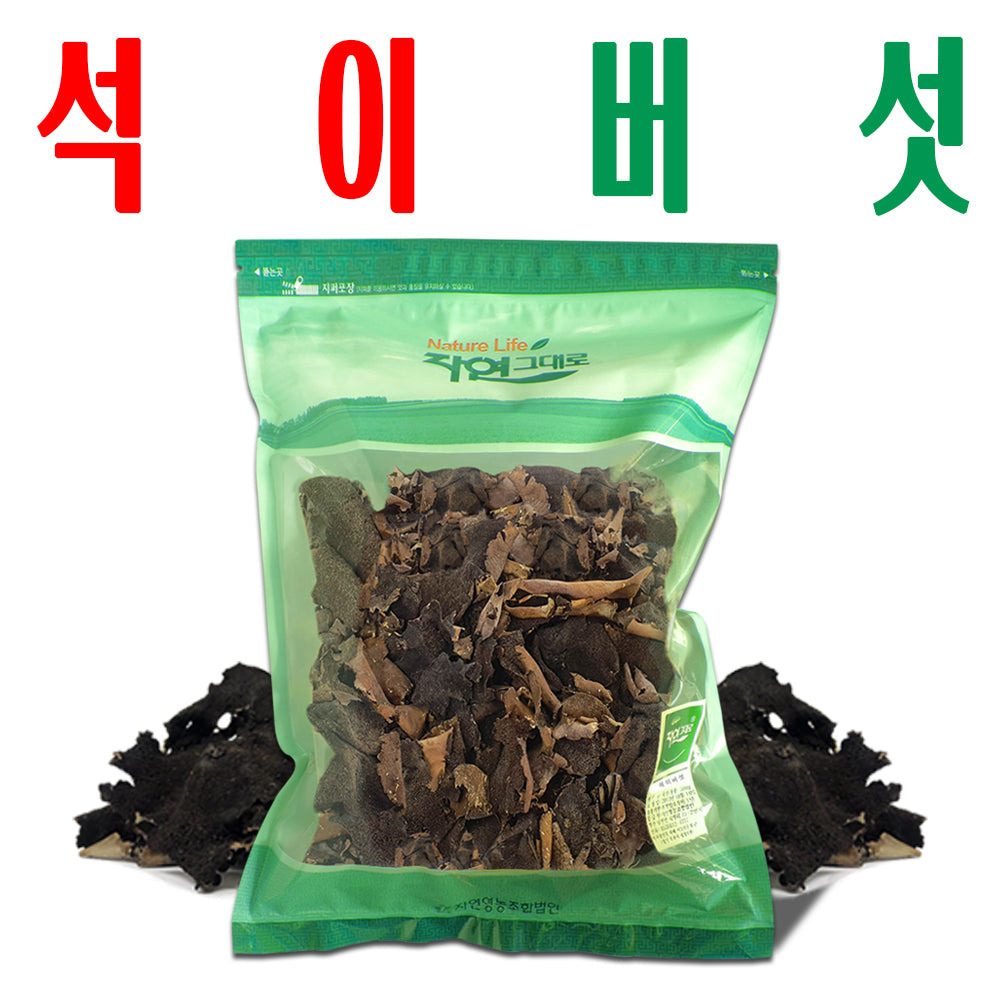
What is 100g of Rock Tripe?100g of Rock Tripe is a product consisting of 100g of naturally dried wild rock tripe harvested from rocks in the high-altitude areas of the Taebaek Mountains. When dried rock tripe is soaked in water, the back of the mushroom turns a deep black color; thus, in terms of color food, rock tripe can be classified as a Black Food. With its clean taste and chewy texture, rock tripe dishes are famous in the East as a premium delicacy. Here is a brief introduction to rock tripe. Rock Tripe (Seogi Mushroom)Rock tripe is a mushroom that grows attached to rocks in clean, deep mountain areas and has a very long lifespan. Although we could harvest wild rock tripe year-round if we chose to, it is quite expensive because it cannot be artificially cultivated and must be gathered from the high-altitude Taebaek Mountain regions. Since the human lifespan is too short to cultivate rock tripe and wait to taste it, no one engages in artificial cultivation of it. LichensThe term "lichen" refers to a group of organisms that "clothe the earth." Lichens cover about 6% of the Earth's land surface and include about 20,000 species. They possess extreme vitality, capable of living anywhere on Earth, including soil, rocks, trees, tombstones, roof tiles, inside rock crevices, tropical regions, deserts, and polar regions. The longest-living lichen in the world today is 8,600 years old, making lichens the longest-living organisms on Earth. Humans, who live for only a century, cannot help but marvel at how the flame of life can burn for such a long time. Seogi (Rock Tripe), Mogi (Wood Ear), Euni (Snow Fungus)Like the character "i" (耳 - ear) at the end of Seogi, the mushrooms Euni and Mogi also share this suffix. They are all mushrooms associated with the ear. If you look at or touch fresh or soaked Seogi, Euni, and Mogi mushrooms, you will understand why they are associated with the ear. Their appearance attached to rocks or trees resembles an ear, and because of the gelatinous substance within, their texture feels soft and pliable like a human earlobe. However, when dried, this connection to the ear is less obvious. The photo below shows dried Seogi, Mogi, and Euni mushrooms. |
||||||||||||||||||||||||||||||||||

|
||||||||||||||||||||||||||||||||||
|
Rock tripe has a distinct difference from Euni and Mogi. While Euni and Mogi are parasitic on trees and obtain nutrients from them, rock tripe does not derive nutrients from rocks; it simply uses the rock as a fixed support. Rock tripe dissolves the rock and sends roots into it to attach its body. Because the roots are not the parts that absorb water and nutrients, they are called pseudo-roots. These must be removed after harvesting or before cooking to prevent a gritty texture when chewing. Since rock fragments may be stuck to these pseudo-roots, they must be removed. The small clump visible inside the circular dotted line below is the pseudo-root of the rock tripe. |
||||||||||||||||||||||||||||||||||

|
||||||||||||||||||||||||||||||||||
|
When you look at the dried rock tripe above, it might look like a black sheet of paper. You might think it would break easily like a cracker when touched, but that is not the case. Due to the gelatinous substance inside, it is tough and does not break easily. After soaking the rock tripe in water and spreading it out with your fingers, you can feel the small, bumpy pseudo-root near the center of the mushroom. Since it is a protrusion near the center of the underside, it is called the mushroom belly button, and it can be easily removed with scissors or your fingers. A famous historical figure associated with rock tripe is 'Lü Buwei'. Lü Buwei was the biological father of Qin Shi Huang during China's Spring and Autumn period and the compiler of 'Lüshi Chunqiu'. The Lüshi Chunqiu was a grand encyclopedia compiled by Lü Buwei by mobilizing over 3,000 scholars. The fact that rock tripe from Mt. Kumgang in Korea was introduced in that encyclopedia shows that its existence has been known to humans for a very long time. Since Lü Buwei passed away in 235 BC, it means that Korea's Mt. Kumgang was famous to the Chinese as far back as 2,200 years ago. In Korea, there are records indicating that people used rock tripe during the Three Kingdoms period. Based on these records and Chinese accounts, we can conclude that our ancestors have had at least 2,200 years of experience using rock tripe. Components of Rock TripeBelow is the general composition table for rock tripe. "Dry matter basis" means the content ratio was calculated with moisture removed. |
||||||||||||||||||||||||||||||||||
|
||||||||||||||||||||||||||||||||||
|
A characteristic of the general composition of rock tripe is that carbohydrates account for the majority. Because rock tripe is a symbiosis of algae and fungi, the algae produce carbohydrates through photosynthesis. Another characteristic is the low ash content, as the mushroom roots cannot absorb mineral components from the rock. Like other mushrooms, the dietary fiber content of rock tripe is very high. Here are a few important, special, and trace components found in rock tripe.
How to use stone mushrooms in folk traditionHere is a brief introduction to how stone mushrooms are used in folk tradition. Before using them, first soak the stone mushrooms in warm salt water, remove the rhizoids, and wash them by rubbing them several times under running water. Because the mushroom lives for hundreds to thousands of years with its bumpy underside close to rocks, it is easy for sand to get stuck to the bottom.
While the water used to soak the mushrooms is discarded, the water used to blanch them is not; it is used as mushroom tea or as a broth for various stews. |
||||||||||||||||||||||||||||||||||
| 1). | Stone mushrooms are wild mushrooms harvested from Mt. Taebaek in Gangwon Province. |
| 2). | The aroma is similar to that of white wood ear or wood ear mushrooms, offering a unique, subtle scent of the mushroom. |
| 3). | The taste of stone mushroom tea is not bitter, with a slight hint of sweetness. |
| 4). | The taste of stone mushroom sashimi is soft with a slightly chewy texture. |
| 5). | The current selling price is quite affordable. |
| Introduction |
The supplier of this product is Nature Farming Association Corporation (CEO: Kim Ju-il) located in Gyeongsan, Gyeongbuk, and the producers are residents of Mt. Taebaek. The Nature Farming Association, which grows, processes, and sells mushrooms, was established in 1997 and successfully achieved the first domestic artificial cultivation of wood ear mushrooms in 2007. It acquired Korean Patent (No. 10-0806484) and Japanese Patent (No. 4624432) for its mushroom freeze-drying method in 2008 and 2010, and began exporting mushroom products to Japan and the Asian region in 2012. Nature Farming Association Corporation uses its patented technique to produce Oxygen Shiitake Mushrooms, which are dried mushrooms with properties nearly identical to fresh mushrooms. Oxygen Shiitake Mushrooms are special mushrooms that retain the tenderness, aroma, and taste of fresh mushrooms while weighing less and having a longer shelf life. Nature Farming Association Corporation produces and processes shiitake, wood ear, oyster, button, king oyster, and enoki mushrooms using eco-friendly farming methods. It produces a total of 48 items and supplies them to Nonghyup Mart, Lotte Mart, Hanaro Mart, Lotte Super, and Lotte Shopping. Additionally, the Nature Farming Association sometimes purchases silver ear mushrooms sourced from overseas or raw stone mushrooms produced in other parts of Korea to repackage and distribute them domestically. |
|---|---|
| Name | Nature Farming Association (CEO: Kim Ju-il) |
| Address | 12-2 Daemyeong-ri, Namcheon-myeon, Gyeongsan-si, Gyeongbuk |

|
|
| 010-3352-7949 |
| 1). | After soaking in warm salt water, remove the rhizoids, lightly cook, and enjoy with sesame oil and salt. |
| 2). | After soaking in warm water, remove the rhizoids and fry in flour batter to enjoy. |
| 3). | After soaking in warm salt water, remove the rhizoids and use as a salad ingredient. |
| 4). | Remove the rhizoids and grind into powder for use in rice cakes (danja, tteok) or porridge. |
| 5). | After soaking in warm salt water, remove the rhizoids and use as a garnish for japchae, stone mushroom side dishes, or noodle dishes. |
| 6). | After soaking in warm salt water, remove the rhizoids and use in seasoned vegetables, stir-fries, or blanched vegetable dishes. |
| 7). | Boil the mushrooms whole without removing the rhizoids, and store in the refrigerator to drink as tea. |
| 8). | You may also use the whole rock tripe, including the base, to make rock tripe liquor. |
| 9). | You can remove the base and use it as an ingredient for white kimchi filling. |
| 10). | Close the zipper at the top of the bag and store it in a dry, cool, and dark place indoors. Please refrigerate for long-term storage. |
| Origin | South Korea |
|---|---|
| Product Composition | 100% Naturally dried rock tripe (seogi mushrooms) |
| Sales Unit | Bag (dried rock tripe inside a plastic bag) |
|---|---|
| Total Capacity | 100g |
| Consumption Period | Difficult to estimate the duration for one bag as it depends on individual usage. |
| Packaging Material | Polyethylene |
| Packaging Size | Width (20.5cm) x Height (29cm) x Bottom depth (7.5cm) |
| Food Type | Dried agricultural product |
|---|---|
| Production Date | As the supplier ships directly, the production date cannot be determined; inquiries can be made at 053-812-4777. |
| Expiry Date | Indicated on the packaging; items with less than 1 month remaining from the shipping date are not sent; inquiries can be made at 053-812-4777. |
This food item is not subject to legal requirements for this. |
This food item is not subject to legal requirements for this. |
This food item is not subject to legal requirements for this. |
| Payment Information |
1). For bank transfer payments, you can pay via PC banking, internet banking, phone banking, or at a bank. |
|---|---|
| Delivery Information |
1). Delivery Method: Courier Service 2). Delivery Region: Nationwide 3). Delivery Cost: Generally free, but some cases may be paid. 4). Delivery Time: 1–3 days: - Orders paid before 3 PM will arrive the next day, and those after 3 PM will arrive the day after. 5). Notes: Additional delivery fees may apply for island regions. For bank transfers, delivery begins after payment is confirmed. Delivery may be slightly delayed during holidays or due to carrier circumstances. |
| Exchange/Return |
1). Cases where exchange/return is possible - Within 7 days of receiving the product. - If the product received differs from the description or advertising, within 3 months of receipt or within 30 days of discovering the fact. 2). Cases where exchange/return is not possible (as per the "Act on the Consumer Protection in Electronic Commerce, Etc.") - If the product is lost or damaged due to customer fault (excluding instances where packaging was opened to check product content). - If the packaging has been opened or damaged and the product value is lost. - If the product value has significantly decreased due to the customer's usage or partial consumption. - If the product value has significantly decreased over time to the point where resale is difficult. - If the packaging of products that can be replicated is damaged. 3). Regarding exchanges and returns, warranty conditions and quality assurance standards follow the "Framework Act on Consumers." 4). Notes: If exchanging or returning due to a change of mind, the customer must bear the return shipping costs. |
| Damage Compensation Complaints, Disputes Handling Standards |
Consumer Dispute Resolution Standards of the Fair Trade Commission |
| Terms of Trade | Terms of Service (https://bit.ly/3qDTO1Q) |
Shipping Cost
Shipping Cost
1. Free Shipping [some exclusions]
2. Free shipping on orders over ₩30,000
Shipping Location
Shipping Location
Shipped from manufacturers located throughout South Korea
Shipping Policy
Shipping Policy
1. Immediate reshipment if the product is lost after dispatch
2. Immediate exchange if the received product is damaged
3. Same-day dispatch (before 12 PM) for next-day receipt
Delivery Company
Delivery Company
CJ Logistics, Logen Express, Korea Post EMS, Lotte Express, etc.
Delivery Scheduled
Delivery Scheduled
1. Purchases made before 12 PM will be received the next day.
2. Purchases made before 2 PM will be received the next day [certain items].
3. Purchases made after 12 PM/2 PM will be received two days later.
Return Policy
Return Policy
1. Returns accepted within 7 days of product receipt
2. Returns accepted within 3 months for products that differ from advertised description
3. Returns accepted within 30 days from the date the discrepancy was discovered
4. Live products are final sale and non-returnable
5. For simple returns, buyer is responsible for round-trip shipping costs
6. For returns due to seller's fault, round-trip shipping is free
Security Policy
Security Policy
Secure payments are made through world-renowned payment companies such as PayPal, Visa, and Mastercard. Your payment information will not be shared with any third parties.
Privacy Policy
Privacy Policy
Your personal information collected for payment and delivery will be securely protected during delivery and discarded after delivery is complete.