Shipping Cost
Shipping Cost
1. Free Shipping [some exclusions]
2. Free shipping on orders over ₩30,000
Shipping Location
Shipping Location
Shipped from manufacturers located throughout South Korea
Shipping Policy
Shipping Policy
1. Immediate reshipment if the product is lost after dispatch
2. Immediate exchange if the received product is damaged
3. Same-day dispatch (before 12 PM) for next-day receipt
Delivery Company
Delivery Company
CJ Logistics, Logen Express, Korea Post EMS, Lotte Express, etc.
Delivery Scheduled
Delivery Scheduled
1. Purchases made before 12 PM will be received the next day.
2. Purchases made before 2 PM will be received the next day [certain items].
3. Purchases made after 12 PM/2 PM will be received two days later.
Return Policy
Return Policy
1. Returns accepted within 7 days of product receipt
2. Returns accepted within 3 months for products that differ from advertised description
3. Returns accepted within 30 days from the date the discrepancy was discovered
4. Live products are final sale and non-returnable
5. For simple returns, buyer is responsible for round-trip shipping costs
6. For returns due to seller's fault, round-trip shipping is free
Security Policy
Security Policy
Secure payments are made through world-renowned payment companies such as PayPal, Visa, and Mastercard. Your payment information will not be shared with any third parties.
Privacy Policy
Privacy Policy
Your personal information collected for payment and delivery will be securely protected during delivery and discarded after delivery is complete.
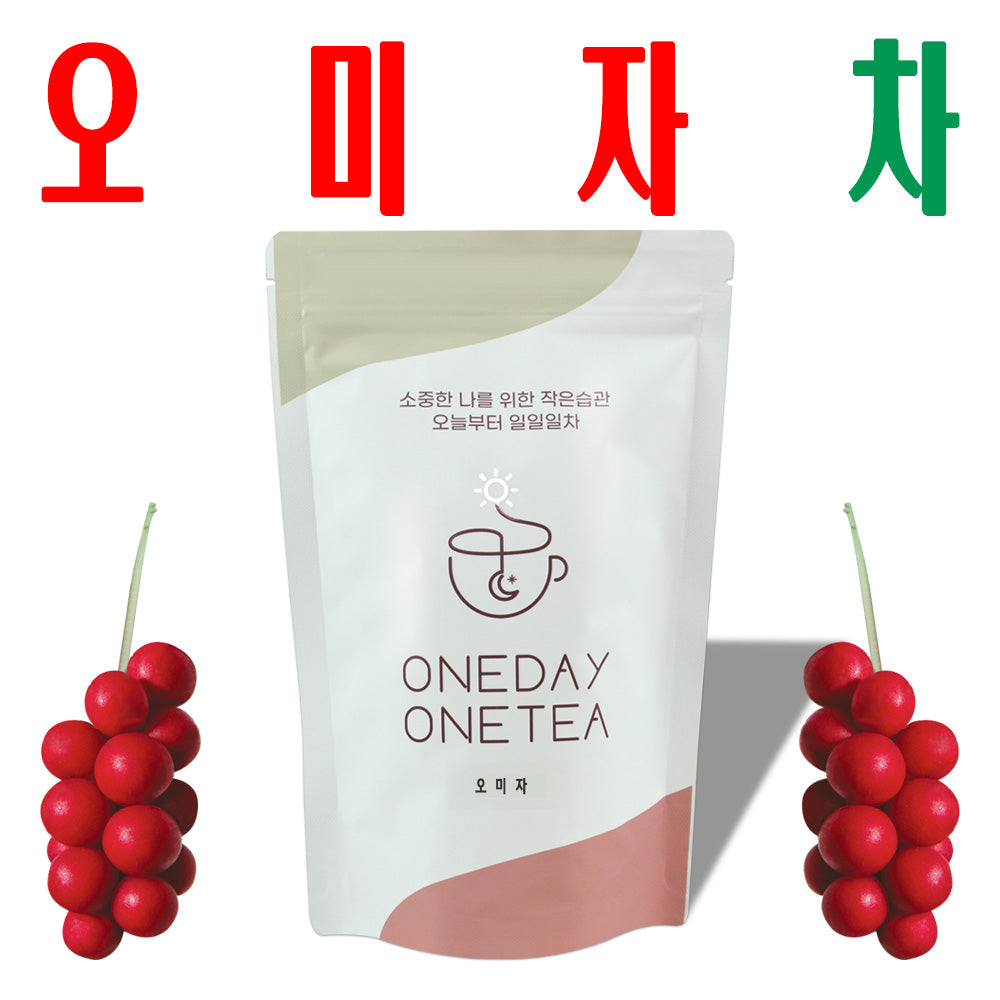
Omija Tea / Omija Tea Bags / Omija Tea Bag 30 Count
Omija Tea / Omija Tea Bags / Omija Tea Bag 30 Count
Schizandra (Omija)
Schizandra Tea / Schizandra Tea Bag / Schizandra Tea Bag Drink / Schizandra Berry Tea

|
||||||||||||||||||||||||||||||||
What is Schizandra tea?Schizandra tea is a convenient single-use tea bag made from dried Schizandra berries. Simply place the tea bag in hot water and steep for 1-2 minutes to fully enjoy the unique taste and aroma of Schizandra. Because of its strong sourness, it is best enjoyed hot with a touch of sweetness; the resulting sweet-and-sour flavor is delicious. Here is a brief introduction to the raw ingredient, Schizandra. Schizandra (Omija)Schizandra is a very famous berry in Korea, historically associated with vital energy (精). It is one of the five berries widely talked about in folk tradition: Schizandra, Bokbunja (Korean black raspberry), Gugija (goji berry), Tosaja (dodder seed), and Sasangja (parsley seed). The Name "Omija"The name Omija (五味子) is a Sino-Korean word composed of the characters for five (五), taste (味), and offspring/seed (子), which perfectly describes the berry's characteristics. It is said that the name was given because you can taste sour and sweet flavors when chewing the pulp and skin together, pungent and bitter flavors when chewing only the seeds, and a salty flavor when chewing the pulp and seeds together. In other words, the five tastes that Schizandra evokes are sweet, bitter, sour, pungent, and salty. Types of Schizandra"Schizandra" is both a specific plant name and a general term used to refer to all similar species. In plant taxonomy, there are 2 genera (屬) and 41 species (種) of plants worldwide called Schizandra. The two genera are Schisandra and Kadsura. In Korea, we find the Northern Schizandra, Black Schizandra, White-fruited Black Schizandra, and 'Gae' (wild) Schizandra of the Schisandra genus, as well as the Kadsura japonica of the Kadsura genus growing in the wild. The species that Koreans commonly call "Omija" is the Northern Schizandra. Native to Korea's Baekdudaegan mountain range, Manchuria, and the Russian Far East, it is the most widely cultivated variety for culinary and health purposes. Kadsura japonica is a wild Schizandra species found in Korea's southern coastal areas, Jeju Island, as well as in China, Japan, and Taiwan. Like Kadsura, Black Schizandra also grows wild in Korea's southern coast, Jeju Island, Japan, Taiwan, and central/western/southern China. Although Black Schizandra grows in the southern part of Korea, it is a type of Northern Schizandra and is classified as a rare (endangered) plant, protected by the Korea Forest Service and the Ministry of Environment. The photo below shows three types of Schizandra native to Korea. You can see that the arrangement of the berries differs slightly between the Northern Schizandra and Kadsura. |
||||||||||||||||||||||||||||||||

|
||||||||||||||||||||||||||||||||
History of SchizandraSchizandra has been recorded in the Shennong Bencao Jing, a medical text from the pre-Christian era (estimated to have been published during China's Qin-Han period), indicating that it has been used for health purposes for at least 2,000 years. It is also mentioned in the Baopuzi, written by Ge Hong (283-343 AD) during China's Eastern Jin Dynasty, which acknowledges Schizandra from Goguryeo as the highest quality. This record confirms that Schizandra was already growing wild in the northern part of the Korean Peninsula before the 4th century. Schizandra is used for food in Korea, China, Japan, and Russia, and is included in each country's traditional health texts as a health ingredient. In Korea, cultivation is active in areas such as Inje, Hoengseong, Danyang, Mungyeong, Sangju, and Jangsu. Why Schizandra is FamousThe first reason for Schizandra's fame is its five flavors. It possesses all five flavors corresponding to the categorization within the Yin-Yang and Five Elements philosophy, which shaped the Eastern worldview. These five flavors are: sour (associated with Wood), bitter (Fire), sweet (Earth), pungent (Metal), and salty (Water). While the tea's dominant flavor is sour, it contains a blend of all five, creating a uniquely complex taste. The second reason for its fame is the color of its berries. Schizandra berries are a captivating red. While black Schizandra does exist, it is extremely rare; most are red. This red Schizandra is a perfect fit for a "pigment food" favored by health-conscious people who live by the motto of achieving longevity through a healthy body and sound mind. The third reason for its fame is the phytoestrogen content found within the berry. Schizandra berries contain substances called Schizandrin and Gomisin. A product using the Schizandrin from these berries was developed in China, and the fact that Korea Hutecs Pharmaceutical began importing and selling it also contributed to its popularity. Composition of Schizandra The general nutritional composition of Schizandra berries is as follows. "Dry basis" in the parentheses below means the figures are calculated with moisture removed. |
||||||||||||||||||||||||||||||||
|
||||||||||||||||||||||||||||||||
|
Schizandra contains carbohydrates, citric acid, malic acid, and unsaturated fatty acids, which blend together to create its complex flavors. The reason it appears to have a high content of crude fat (around 25%) is because of the seeds. The seeds are rich in unsaturated fatty acids. Below is a brief introduction to some of the important, special, and trace components of Schizandra.
Traditional Uses of SchizandraBelow is a brief introduction to how Schizandra is traditionally used in Korea and abroad.
The fruit, bark, and roots of the Omija tree are all used for health purposes, and all possess a warm nature. |
| 1). | Raw materials for the Omija tea are supplied by the Korea Herbal Medicine Association. |
| 2). | It is a pure tea with no additives—no preservatives, no artificial colors, and no artificial flavors. |
| 3). | The tea bag containing the tea particles is made of biodegradable, eco-friendly fiber that can be recycled as compost. |
| 4). | The tea bag material has received European certification as a food-contact material harmless to the human body. |
| 5). | The tea bag string is made extra long so that the tea can be brewed in bottles or tumblers. |
| 6). | The packaging is an aluminum zipper bag, which is resistant to moisture, helping to preserve the taste and aroma for a long time. |
| 7). | The tea has a strong sour taste, and the aroma is the very distinct, natural scent of Omija. |
| About Us |
The product supplier is Onyudam (CEOs: Yoon Sung-hyun, Jo Su-in), and the manufacturer is Hapcheon Herbal Processing Agricultural Corporation (CEO: Baek Moon-gi). CEO Baek, who had been running a health herb farm with his parents for over 20 years, established the Hapcheon Herbal Processing Agricultural Corporation in 1996 and built a processing plant the following year. The company first won the $500,000 Export Tower award in 2003, and CEO Baek has served as the 17th and 18th chairman of the Korea Herbal Medicine Association. Hapcheon Herbal Processing Agricultural Corporation cultivates about 60 types of health plants in Hapcheon-eup, Hapcheon-gun, where the corporation is located, including chrysanthemum, hydrangea, mulberry, persimmon, peony, achyranthes, safflower, motherwort, Omija, goji berry, cornelian cherry, astragalus, green tea, silver vine, and bellflower, and uses them as ingredients for health tea. The company sells its products through domestic and international channels and also supplies products to other companies through OEM manufacturing. Hapcheon Herbal Processing Agricultural Corporation received the Minister of Agriculture and Forestry Award in 2002, registered the trademark 'Sangrime' in 2007, received the international food safety standard ISO22000 certification in 2015, and was registered as a venture company in the same year. In 2017, it registered a patent for a bellflower tea manufacturing method, in 2018 it received the Ministry of Food and Drug Safety HACCP certification (No. 2018-2-9156), and in 2019 it received organic certification (No. 17100199) for chrysanthemum crops, establishing itself as a small but strong enterprise. A brief introduction to Hapcheon Herbal Processing Agricultural Corporation is provided below. |
|---|---|
| Name | Hapcheon Herbal Processing Agricultural Corporation (CEO: Baek Moon-gi) |
| Address | 16, Naegok-gil, Hapcheon-eup, Hapcheon-gun, Gyeongsangnam-do |

|
|
| 010-3352-7949 |
| 1). | Place the tea bag in hot water and brew for 2-3 minutes before drinking. |
| 2). | You can enjoy the tea regardless of meals, but it is better to drink it on an empty stomach. |
| 3). | Since it has a strong sour taste, it is recommended to add sweeteners like sugar or honey. |
| 4). | The taste is better when served hot rather than cooled down. |
| 5). | Store in a cool, dry place away from direct sunlight. |
| Ingredients | Omija |
|---|---|
| Origin | Republic of Korea |
| Content | 100% Omija berries |
| Nutritional Facts | Not legally applicable |
| Sales Unit | Bag (contains 30 tea bags in a polyethylene pouch) |
|---|---|
| Total Net Weight | 30g (1g x 30 tea bags) |
| Consumption Period | Difficult to measure, as it depends on individual consumption habits. |
| Packaging Material | Tea bag: Biodegradable fiber Plastic bag: Polyethylene |
| Package Size | Width 15cm x Height 23cm x Thickness 6.5cm |
| Food Type | Tea (Single-ingredient infusion tea) |
|---|---|
| Manufacturing Date | Manufacturing date cannot be determined as products are shipped from the supplier's refrigerated warehouse; for inquiries: 02-967-8133 |
| Expiration Date | Marked on the outer package; we do not ship products with less than 1 month of shelf life from the shipping date; for inquiries: 02-967-8133 |
| Not legally applicable. |
| Not legally applicable. |
| Not legally applicable. |
| Payment Information |
1). For bank transfers, you can make payments via PC banking, internet banking, phone banking, or at a bank branch. - The name of the depositor must match the name provided during the order, and orders not paid for within 3 days will be automatically canceled. 2). For credit card or simple payments, the system processes the payment immediately, so no further action is required. |
|---|---|
| Shipping Information |
1). Delivery Method: Courier service 2). Delivery Region: Nationwide 3). Shipping Fee: Generally free, but some items may incur a fee 4). Delivery Period: 1 to 3 days: - Orders paid for before 3:00 PM are expected to arrive the next day; orders paid for after 3:00 PM will arrive the day after next. 5). Notes:- Additional shipping fees may apply for island regions. - For bank transfers, shipping begins only after your payment is confirmed. - Delivery may be delayed during holidays or due to special circumstances at the courier company. |
| Exchange/Return |
1). Cases where exchange and return are possible
- Exchanges/returns are possible within 7 days of receiving the product. - If the received product differs from the product description or advertising, within 3 months of receipt or 30 days from the date you became aware of the discrepancy. 2). Cases where exchange and return are not possible (Reasons for restricting the withdrawal of subscription under the "E-Commerce Consumer Protection Act")- If the product is lost or damaged due to the customer's fault (excluding cases where the packaging is damaged to inspect the product). - If the packaging has been opened or damaged, resulting in a loss of product value. - If the product value has significantly decreased due to the customer's use or partial consumption. - If the product value has significantly decreased over time, making resale difficult. - If the packaging of products that can be duplicated has been damaged. 3). Warranty conditions and quality assurance standards follow the "Framework Act on Consumers."4). Notes: - If you request an exchange or return due to a change of mind, you must bear the shipping costs. |
| Damage Compensation/ Complaint/ Dispute Resolution Standards |
Fair Trade Commission's Consumer Dispute Resolution Standards |
| Terms and Conditions | Terms of Use (https://bit.ly/3qDTO1Q) |
Shipping Cost
Shipping Cost
1. Free Shipping [some exclusions]
2. Free shipping on orders over ₩30,000
Shipping Location
Shipping Location
Shipped from manufacturers located throughout South Korea
Shipping Policy
Shipping Policy
1. Immediate reshipment if the product is lost after dispatch
2. Immediate exchange if the received product is damaged
3. Same-day dispatch (before 12 PM) for next-day receipt
Delivery Company
Delivery Company
CJ Logistics, Logen Express, Korea Post EMS, Lotte Express, etc.
Delivery Scheduled
Delivery Scheduled
1. Purchases made before 12 PM will be received the next day.
2. Purchases made before 2 PM will be received the next day [certain items].
3. Purchases made after 12 PM/2 PM will be received two days later.
Return Policy
Return Policy
1. Returns accepted within 7 days of product receipt
2. Returns accepted within 3 months for products that differ from advertised description
3. Returns accepted within 30 days from the date the discrepancy was discovered
4. Live products are final sale and non-returnable
5. For simple returns, buyer is responsible for round-trip shipping costs
6. For returns due to seller's fault, round-trip shipping is free
Security Policy
Security Policy
Secure payments are made through world-renowned payment companies such as PayPal, Visa, and Mastercard. Your payment information will not be shared with any third parties.
Privacy Policy
Privacy Policy
Your personal information collected for payment and delivery will be securely protected during delivery and discarded after delivery is complete.