Costo de envío
Costo de envío
1. Envío gratuito[algunos]
2. Compras de 30.000 wones o más envío gratuito
Ubicación de envío
Ubicación de envío
Enviado por fabricantes ubicados en diversas partes de Corea
Política de envío
Política de envío
1. Reenvío inmediato si el producto se pierde después del envío.
2. Sustitución inmediata si el producto recibido está dañado.
3. Envío el mismo día [antes de las 12h] y recepción al día siguiente.
Empresa de envíos
Empresa de envíos
CJ Logistics, Rosen Delivery, Korea Post, Lotte Delivery, etc.
Tiempo de entrega estimado
Tiempo de entrega estimado
1. Compras antes de las 12:00: recepción del producto al día siguiente
2. Compras antes de las 14:00: recepción del producto al día siguiente [en algunos casos]
3. Compras después de las 12:00/14:00: recepción del producto 2 días después
Política de devoluciones
Política de devoluciones
1. Devoluciones aceptadas dentro de los 7 días posteriores a la recepción del producto.
2. Los productos que superen lo indicado en el anuncio podrán ser devueltos en un plazo de 3 meses.
3. Devoluciones aceptadas dentro de los 30 días siguientes a la fecha de conocimiento de tal hecho.
4. Los productos biológicos son productos de venta final y no se pueden devolver.
5. En caso de devolución simple, los gastos de envío de ida y vuelta correrán a cargo del comprador.
6. En caso de devolución por causa imputable al vendedor, los gastos de envío de ida y vuelta serán gratuitos.
Política de seguridad
Política de seguridad
Los pagos seguros se realizan a través de empresas de pago de renombre mundial como PayPal, Visa y MasterCard. La información de su pago no se comparte con ninguna institución.
Política de privacidad
Política de privacidad
Sus datos personales, recopilados para el pago y el envío, se protegerán de forma segura durante el envío y se eliminarán una vez completada la entrega.
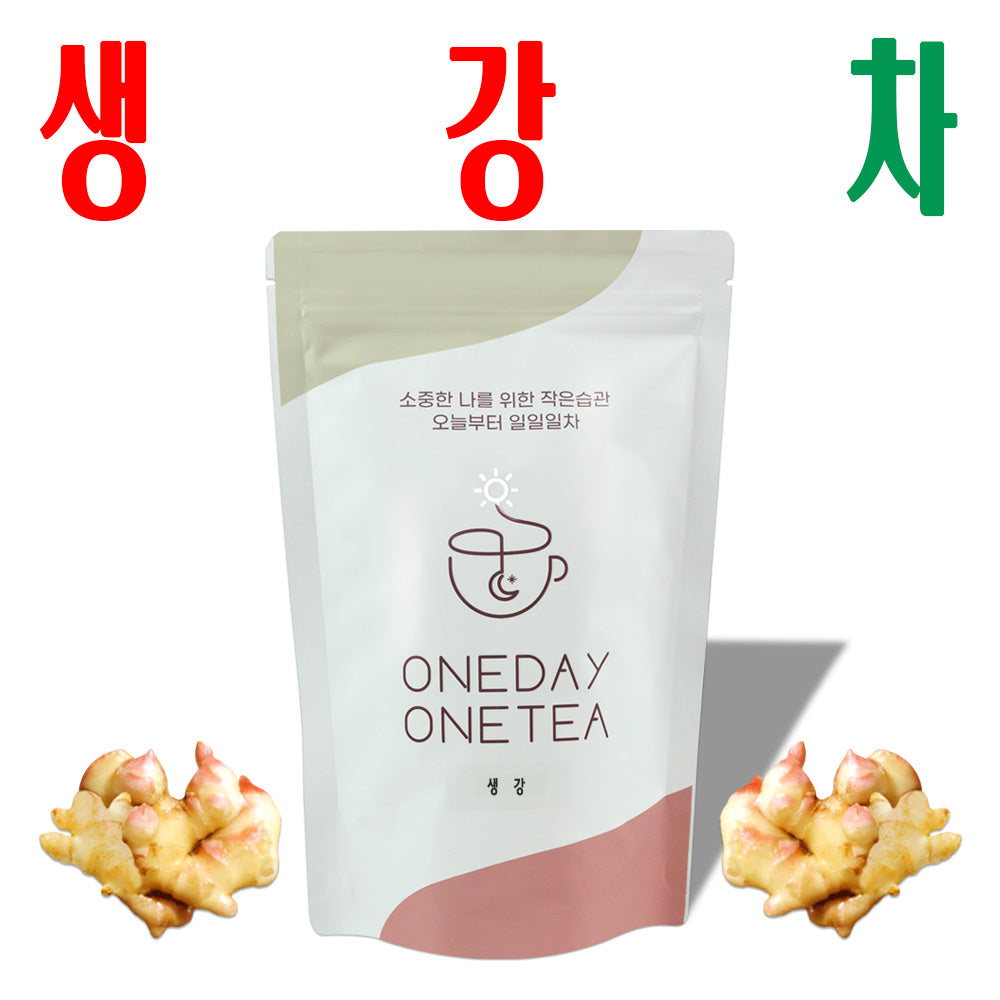
Ginger Tea / Ginger Tea Bags / Ginger Tea Bags (30 count)
Ginger Tea / Ginger Tea Bags / Ginger Tea Bags (30 count)
Ginger
Ginger tea/Ginger tea bag/Ginger tea bag/Gingerol

|
||||||||||||||
What is ginger tea?Ginger tea is a single-serving tea bag made from dried ginger roots. Simply place a tea bag in hot water and steep for 1-2 minutes to fully enjoy the unique taste and aroma of ginger. Because ginger tea has a strong, spicy flavor and a pleasant fragrance, it is widely enjoyed as both a health tea and a refreshing beverage. Here is a brief introduction to the raw material, ginger. GingerGinger (Saeng-gang) is called "sae-ang" or "sae-yang" in pure Korean, terms that evolved from the pronunciation of the Sino-Korean word 生薑. I have fond childhood memories of village elders storing ginger in earthen cellars built into loess cliffs. Due to its pungent aroma and spicy taste, ginger is a beloved spice, seasoning, and healthy vegetable around the world. It is said that the character "gang" (薑) in the name "saeng-gang" (生薑) originated from the meaning "a plant that wards off evil." The term "gang-eo" (疆禦) means to repel. This interpretation comes from the great Song dynasty scholar, Wang Anshi. The name likely arose because of the popular belief that ginger protected humans from ghosts and harmful animals. Given records that indigenous people in the tropical islands south of China used ginger in religious ceremonies to exorcise evil spirits, Wang Anshi's interpretation seems plausible. The origin of ginger is in the islands spanning from Singapore and Malaysia to the Philippines, a region specifically known as "Maritime Southeast Asia." While it is unknown exactly when ginger arrived in Korea, it was recorded as being cultivated in 1018 during the Goryeo Dynasty, and was listed as a medicinal herb in the Hyangyak Gugeupbang (estimated to be published in 1236), showing that ginger has been part of our ancestors' lives for at least a thousand years. Humans began cultivating ginger about 5,000 years ago. It spread from its origin to India around 3,500 years ago, entered Greece and Rome in the 1st century AD, reached England in the 11th century, and spread to the Americas in the 16th century, establishing itself as a global root vegetable and spice today. Judging by its inclusion in the Chinese medical text Shennong Bencaojing and the ancient Indian medical text Ayurveda, humanity has been using ginger for health purposes for at least 2,000 years. Ginger is planted in the spring (April-May) and harvested around October-November. In Korea, major production areas are Jeonbuk, Chungnam, and Gyeongbuk, with Wanju-gun in Jeonbuk being the largest producer. India is the world's largest ginger producer, with Nigeria, China, and Indonesia also being major producers. Below are photos of moisture-rich ginger and its cross-section. |
||||||||||||||

|
||||||||||||||
Types of GingerGinger is a perennial tropical/subtropical plant belonging to the genus Zingiber. There are about 150 species within the genus. Ginger varieties are classified into early-maturing, medium-to-late, and late-maturing types, which differ in their level of pungency. Terms like "geon-gang" (dried ginger) or "pyeon-gang" (sliced ginger) do not refer to ginger varieties, but rather to how the ginger was processed for its intended use. Saeng-gang (生薑) refers to raw ginger root, also called fresh ginger. Typically, ginger is peeled and pickled in vinegar or alcohol, crushed or juiced for seasoning in seafood, meat, vegetable dishes, or kimchi, steeped in hot water, thinly sliced and soaked in honey, or used to make candied ginger. Geon-gang (乾薑) refers to dried ginger. There are specific names depending on the drying method: dried with the skin on is geon-saeng-gang (dried raw ginger); peeled and dried is baek-gang (white ginger); peeled, dried, and steamed/processed is geon-gang (dried ginger); and peeled and charred black is heuk-gang (black ginger). Their uses vary slightly. Dried ginger powder is often used in curry, bread, cookies, crackers, cakes, beer, and carbonated drinks. Pyeon-gang (片薑) is made by peeling, slicing, boiling in water to reduce spiciness, simmering in starch syrup, and coating in sugar before drying. Pyeon-gang is commonly used as a snack or appetizer; the image below shows pyeon-gang. |
||||||||||||||

|
||||||||||||||
|
Whether in the East or West, ginger is used in many ways globally. Fresh ginger, dried ginger, and sliced ginger are all used for food and health purposes. Even ginger leaves and root skins are used for edible and health applications. Components of GingerBelow is the general composition table for ginger from the USDA. "Dry matter basis" in the parentheses means the figures were calculated after removing moisture. |
||||||||||||||
|
||||||||||||||
|
There is nothing unusual in the general composition of ginger root. Here are a few important, special, and minor components.
Ginger's SpicinessThe spicy taste comes from gingerols and shogaols. If you have chewed a Cheongyang chili pepper, you know how intense it is, as it leaves your mouth burning. The spicy substance in chili peppers is called capsaicin, and in black pepper, it is called piperine. Comparing the intensity of spicy substances in chili, black pepper, and ginger: Ginger gingerol (1) < Black pepper piperine (1.7) < Dried ginger shogaol (2.7) < Chili capsaicin (270). Shogaol, which is created when ginger is heated, is 2.7 times spicier than gingerol. Therefore, dried ginger, which contains shogaol (not present in raw ginger), is generally spicier than fresh ginger. Of course, dried ginger is also spicier partly because it has less moisture than fresh ginger. |
| 1). | The raw ingredients for our ginger tea are supplied by the Korea Herbal Medicine Association. |
| 2). | It is a pure tea with no preservatives, colors, or flavors added. |
| 3). | The tea bag containing the tea leaves is made of eco-friendly fiber that is biodegradable and compostable. |
| 4). | The tea bag material is European-certified as a food-contact substance harmless to the human body. |
| 5). | We have designed the tea bag string to be long, making it easy to steep in bottles or tumblers. |
| 6). | The packaging is an aluminum zipper bag, which is moisture-resistant to preserve the taste and aroma for a long time. |
| 7). | While the tea has a spicy flavor and pungent aroma, it makes you feel warm and refreshed, making it a truly enjoyable tea to drink. |
| Intro |
The supplier of this product is Onyudam (CEOs: Yoon Sung-hyun, Jo Su-in), and the manufacturer is Hapcheon Herbal Processing Farming Association (CEO: Baek Moon-gi). CEO Baek, who operated a medicinal herb farm with his parents for over 20 years, founded the Hapcheon Herbal Processing Farming Association in 1996, established a processing plant the following year, received the $500,000 Export Tower award in 2003, and served as the 17th-18th president of the Korea Herbal Medicine Association. The Hapcheon Herbal Processing Farming Association cultivates over 60 types of medicinal plants, including chrysanthemum, hydrangea, mulberry, persimmon, peony, achyranthes, safflower, motherwort, schisandra, matrimony vine, dogwood, milk vetch, green tea, actinidia, and balloon flower, all used as raw materials for their health teas. The association sells its products through domestic and international channels and also supplies products to other companies via OEM. The association received the Minister of Agriculture and Forestry Award in 2002, trademarked 'Sangrime' in 2007, received the international food safety certification ISO22000 in 2015, was registered as a venture company in the same year, patented a balloon flower tea production method in 2017, received the HACCP certification from the Ministry of Food and Drug Safety in 2018 (No. 2018-2-9156), and received organic certification for chrysanthemum (No. 17100199) in 2019, establishing its status as a strong, small business. Below is a brief introduction to the Hapcheon Herbal Processing Farming Association. |
|---|---|
| Name | Hapcheon Herbal Processing Farming Association (CEO: Baek Moon-gi) |
| Address | 16, Naegok-gil, Hapcheon-eup, Hapcheon-gun, Gyeongnam, South Korea |

|
|
| 010-3352-7949 |
| 1). | Place the tea bag in hot water and let it steep for 2-3 minutes before drinking. |
| 2). | You may enjoy the tea at any time, before or after meals. |
| 3). | As this tea has a strong taste and aroma, those with sensitive stomachs are advised to drink it after meals. |
| 4). | The tea is very enjoyable when sweetened to your preference. |
| 5). | Ginger tea tastes better when served hot rather than cold. |
| 6). | Store in a cool, dry place away from direct sunlight. |
| Ingredients | Ginger |
|---|---|
| Origin | South Korea |
| Composition | Ginger Root 100% |
| Nutrition Facts | Not legally applicable |
| Sales Unit | Bag (contains 30 tea bags inside a polyethylene pouch) |
|---|---|
| Total Content | 30g (1g x 30 tea bags) |
| Consumption Period | It is difficult to estimate the consumption period for one bag as it depends on individual usage. |
| Packaging Material | Tea bag: Biodegradable fiber Plastic bag: Polyethylene |
| Package Size | 15cm wide x 23cm long x 6.5cm thick |
| Food Type | Tea (Single-ingredient infusion tea) |
|---|---|
| Manufacturing Date | As items are shipped from the supplier's cold storage, the date of manufacture cannot be identified. For inquiries: 02-967-8133 |
| Expiry Date | Marked on the outer packaging. Items with less than 1 month of shelf life remaining from the date of shipment will not be sent. For inquiries: 02-967-8133 |
| Not legally applicable. |
| Not legally applicable. |
| Not legally applicable. |
| Payment |
1). For bank transfers, please make the payment via PC banking, internet banking, phone banking, or at a bank branch. - The name of the depositor must match the name provided during the order. Orders not paid within 3 days are automatically canceled. 2). For credit card or simple payments, the system processes the payment immediately, requiring no further action. |
|---|---|
| Delivery |
1). Method : Courier 2). Area : Nationwide 3). Fee : Generally free, though some exceptions apply 4). Duration : 1~3 days: - Orders paid before 3:00 PM are usually delivered the next day; orders paid after 3:00 PM are delivered the following day. 5). Notes :- Additional shipping fees may apply for island regions. - For bank transfers, shipping begins only after payment confirmation. - Deliveries may be slightly delayed during holidays or due to carrier circumstances. |
| Exchanges/Returns |
1). Eligibility for Exchange/Return
- Within 7 days of receiving the product. - If the product differs from the description, within 3 months of delivery or 30 days from the date of discovery. 2). Ineligibility for Exchange/Return (as per Consumer Protection Law)- If the product is lost or damaged due to customer fault (excluding inspection of packaging). - If the product value has decreased due to opening or damaging the packaging. - If the product value has significantly decreased due to customer use or partial consumption. - If the product value has significantly decreased over time, making resale difficult. - If packaging of reproducible products has been damaged. 3). Warranties and quality standards follow the "Framework Act on Consumers."4). Notes: - Shipping costs for exchanges or returns due to a change of heart are covered by the customer. |
| Damages/ Complaints/ Disputes |
Fair Trade Commission Consumer Dispute Resolution Standards |
| Terms of Service | Terms of Service (https://bit.ly/3qDTO1Q) |
Costo de envío
Costo de envío
1. Envío gratuito[algunos]
2. Compras de 30.000 wones o más envío gratuito
Ubicación de envío
Ubicación de envío
Enviado por fabricantes ubicados en diversas partes de Corea
Política de envío
Política de envío
1. Reenvío inmediato si el producto se pierde después del envío.
2. Sustitución inmediata si el producto recibido está dañado.
3. Envío el mismo día [antes de las 12h] y recepción al día siguiente.
Empresa de envíos
Empresa de envíos
CJ Logistics, Rosen Delivery, Korea Post, Lotte Delivery, etc.
Tiempo de entrega estimado
Tiempo de entrega estimado
1. Compras antes de las 12:00: recepción del producto al día siguiente
2. Compras antes de las 14:00: recepción del producto al día siguiente [en algunos casos]
3. Compras después de las 12:00/14:00: recepción del producto 2 días después
Política de devoluciones
Política de devoluciones
1. Devoluciones aceptadas dentro de los 7 días posteriores a la recepción del producto.
2. Los productos que superen lo indicado en el anuncio podrán ser devueltos en un plazo de 3 meses.
3. Devoluciones aceptadas dentro de los 30 días siguientes a la fecha de conocimiento de tal hecho.
4. Los productos biológicos son productos de venta final y no se pueden devolver.
5. En caso de devolución simple, los gastos de envío de ida y vuelta correrán a cargo del comprador.
6. En caso de devolución por causa imputable al vendedor, los gastos de envío de ida y vuelta serán gratuitos.
Política de seguridad
Política de seguridad
Los pagos seguros se realizan a través de empresas de pago de renombre mundial como PayPal, Visa y MasterCard. La información de su pago no se comparte con ninguna institución.
Política de privacidad
Política de privacidad
Sus datos personales, recopilados para el pago y el envío, se protegerán de forma segura durante el envío y se eliminarán una vez completada la entrega.